12 Sustainable Materials Changing Home Design in 2026
Who Is This Guide For?
Whether you are building new, renovating, or simply making healthier material choices room by room, this guide gives you the clarity and confidence to choose sustainable materials that last.
🏠
First-Time Homeowners
You are making foundational material choices now. This guide helps you avoid costly conventional defaults and start with materials that hold their value and reduce long-term maintenance.
🔨
Homeowners Planning a Renovation
You want to swap out harmful or outdated materials. This guide shows you sustainable alternatives for every part of the home, with climate and cost guidance.
🌱
Sustainability-Conscious Buyers
You care about embodied carbon, toxin-free interiors, and environmental impact. This guide gives you the vocabulary and evidence to make truly green choices.
🏗️
Self-Build and Owner-Builder Projects
You are managing your own construction process and need practical, globally applicable material knowledge. This guide is your field-ready decision-making reference.
Quick Navigation
| 1️⃣ Why Materials Matter Sections 1–2 · Understand how material choices affect health, carbon, cost and climate performance. | 3️⃣ Natural & Engineered Materials Sections 3–4 · Explore bamboo, hempcrete, CLT, cork and the most promising materials for sustainable homes. |
| 5️⃣ Recycled & Interior Materials Sections 5–6 · Discover reclaimed materials, recycled content and healthy interior finish options. | 7️⃣ Climate, Cost & Action Sections 7–10 · Match materials to your climate, weigh the true cost, avoid common mistakes and use the checklist. |
01 Why Materials Matter
The Hidden Cost of Conventional Materials
Most homes are built the same way: concrete, fired brick, steel, and synthetic finishes. These materials are widely available and easy to specify, but they carry enormous environmental and health costs that rarely appear on a builder’s quote.
Ordinary Portland cement is responsible for approximately 8% of global carbon dioxide emissions. Fired clay bricks require temperatures of over 900°C to manufacture. Synthetic paints and adhesives off-gas volatile organic compounds (VOCs) for years after installation. These are not niche concerns — they are the baseline of conventional construction.
The material choices made during construction set the performance ceiling of a home for decades. A home built with low-carbon, climate-appropriate, and non-toxic materials will outperform a conventional one in energy bills, air quality, durability, and resale value.
💡 TIP: Start With What You Know
Before researching alternatives, list every material currently in your home or planned for your build. Categorise by room: structural, finishes, insulation, fixtures. This audit becomes the foundation of your sustainable material roadmap.
How Materials Shape Indoor Health
The World Health Organisation estimates that indoor air can be two to five times more polluted than outdoor air in urban environments. The primary source of that pollution is the materials inside your home.
Formaldehyde from composite wood panels, VOCs from solvent-based paints, and off-gassing from synthetic carpets accumulate in sealed, air-conditioned spaces. Children, the elderly, and anyone with respiratory conditions are most affected. Switching to low-VOC, natural, and non-toxic materials is one of the highest-leverage health interventions available to a homeowner.
📌 CALLOUT: Why This Matters in 2026
Over 60% of a typical home’s lifecycle carbon comes from the materials used in construction — not from energy bills. Addressing embodied carbon through better material selection is the single most impactful action a homeowner can take before the first brick is laid.
Materials as Long-Term Investment
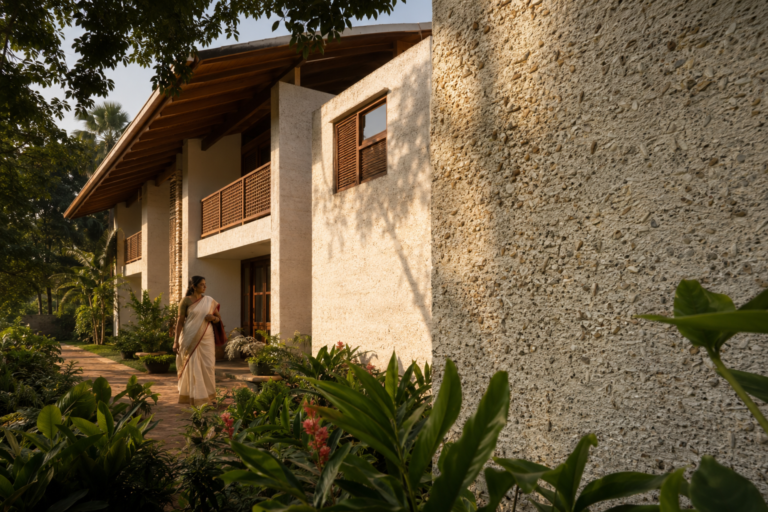
A rammed earth wall in Rajasthan, a hempcrete home in Kent, or a bamboo structure in Bali — each of these uses materials with track records measured in decades or centuries, not years. Natural and recycled materials tend to age with character, improve with time, and require significantly less energy to maintain.
Understanding sustainable materials is not an environmental statement. It is a practical decision that affects your health, your finances, and the long-term value of the most significant asset you will ever own.
⚠️ WARNING: Do Not Greenwash Yourself
Many products marketed as ‘eco-friendly’ use recycled content in only 5–10% of their composition. Always ask for a full material declaration (Environmental Product Declaration / EPD) before accepting a sustainability claim.
02 Understanding embodied carbon
What Is Embodied Carbon?
Embodied carbon refers to all greenhouse gas emissions associated with a material across its entire lifecycle — from raw material extraction and manufacturing to transportation, installation, maintenance, and eventual demolition and disposal.
Unlike operational carbon (the emissions from heating, cooling, and powering your home), embodied carbon is locked in before you move in. You cannot reduce it by installing solar panels later. The only way to address embodied carbon is to choose lower-carbon materials from the start.
The Embodied Carbon Scale
Materials vary enormously in their embodied carbon. The table below gives approximate carbon intensity per kilogram of material:
| Material | kgCO₂e per kg | Rating |
| Aluminium (virgin) | ~8.24 | 🔴 Very High |
| Portland Cement | ~0.83 | 🟠 High |
| Structural Steel | ~2.89 | 🔴 Very High |
| Concrete (30MPa) | ~0.13 | 🟡 Medium |
| Fired Clay Brick | ~0.22 | 🟡 Medium |
| CLT Timber | ~−0.8 (stored) | 🟢 Low (stores carbon) |
| Bamboo | ~−1.5 (stored) | 🟢 Very Low (sequesters) |
| Hempcrete | ~−0.7 (stored) | 🟢 Net Zero or Negative |
| Rammed Earth | ~0.02 | 🟢 Very Low |
| Recycled Steel | ~0.43 | 🟢 Low |
📌 CALLOUT: Embodied Carbon Benchmark
The UK’s RIBA 2030 Climate Challenge targets whole-life carbon of under 500 kgCO₂e/m² for residential buildings. Conventional construction often reaches 700–900 kgCO₂e/m². Using lower-carbon materials can cut this figure in half without significant cost premium.
Lifecycle Thinking: From Cradle to Grave
True sustainability requires lifecycle thinking. A material is not sustainable simply because it looks natural or carries a green label. You must consider the full chain: where was it extracted, how was it processed, how far was it transported, how long will it last, and what happens when it reaches end of life?
Bamboo grown locally in Kerala and used within 200 kilometres has a vastly different carbon footprint from bamboo harvested in China, processed in Vietnam, and shipped to a project in Dubai. Local sourcing is always the first filter.
💡 TIP: Use the EPD Database
The Embodied Carbon in Construction Calculator (EC3) and the ICE Database (University of Bath) allow you to compare verified embodied carbon data for hundreds of materials. These are free, public resources every homeowner and architect should reference.
Whole-Life Cost vs. Upfront Cost
A rammed earth wall costs more to build than a plastered brick wall. But it requires no painting, minimal maintenance, provides passive thermal mass, and lasts 500 years. The whole-life cost calculation — over 30 or 50 years — almost always favours natural and sustainable materials.
⚠️ WARNING: Do Not Confuse Recyclable With Recycled
Recyclable means a material could be recycled at end of life. Recycled content means it already was. For embodied carbon purposes, only the latter reduces upstream emissions. Always verify the percentage of recycled content in any claimed ‘green’ product.
03 Natural Materials
Bamboo: The 5-Year Renewable
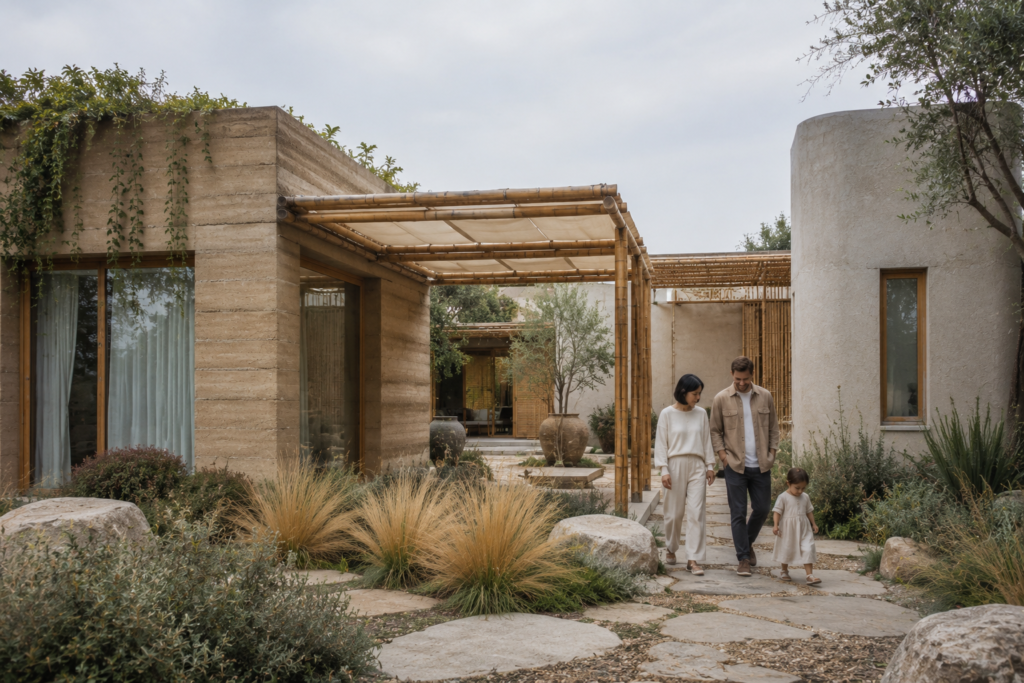
Bamboo is one of the most remarkable building materials on earth. It grows to full harvestable maturity in 3–5 years, sequesters more carbon per hectare than most forests, and achieves compressive strengths comparable to concrete and tensile strength close to structural steel.
In South and Southeast Asia — India, Bangladesh, Indonesia, Vietnam — bamboo has been used in construction for thousands of years. Modern engineered bamboo products (laminated bamboo panels, strand bamboo flooring, glulam bamboo beams) are now competitive with premium timber in performance and aesthetics. Projects in Bali, Kerala, and Bogota have proven bamboo’s viability as a primary structural and finish material at architectural scale.
For homeowners, bamboo works well as flooring, wall cladding, ceiling panels, screen elements, and furniture. Ensure any product uses low-formaldehyde adhesives and UV-stable finishes to maximise durability and indoor air quality.
📌 CALLOUT: Material Spotlight
Bamboo sequesters approximately 12 tonnes of CO₂ per hectare per year — compared to a mature forest’s average of 6 tonnes. It is the fastest-growing plant on earth, making it a genuinely renewable building material when sourced responsibly.
Hempcrete: The Breathing Wall
Hempcrete is a composite of hemp shiv (the woody core of the hemp stalk), lime binder, and water. It is not structural — it requires a timber or steel frame — but as an infill and insulation material it is extraordinary.
Hempcrete walls regulate humidity naturally, absorbing and releasing moisture without the risk of mould. They provide excellent thermal mass in temperate climates, making homes cooler in summer and warmer in winter without mechanical intervention. Hemp is carbon-negative during growth, and the lime binder re-absorbs CO₂ over time through carbonation, giving hempcrete a net carbon-negative or near-zero profile.
Hempcrete is increasingly available in India, the UK, France, Australia, and North America. Pre-cast hempcrete blocks are now commercially produced, reducing on-site skill requirements.
💡 TIP: Source Within 500km
The single fastest way to reduce the embodied carbon of any natural material is to source it locally. Bamboo grown and processed in Karnataka used in a Bangalore project has a fraction of the carbon footprint of imported bamboo from China.
Rammed Earth: The 500-Year Wall
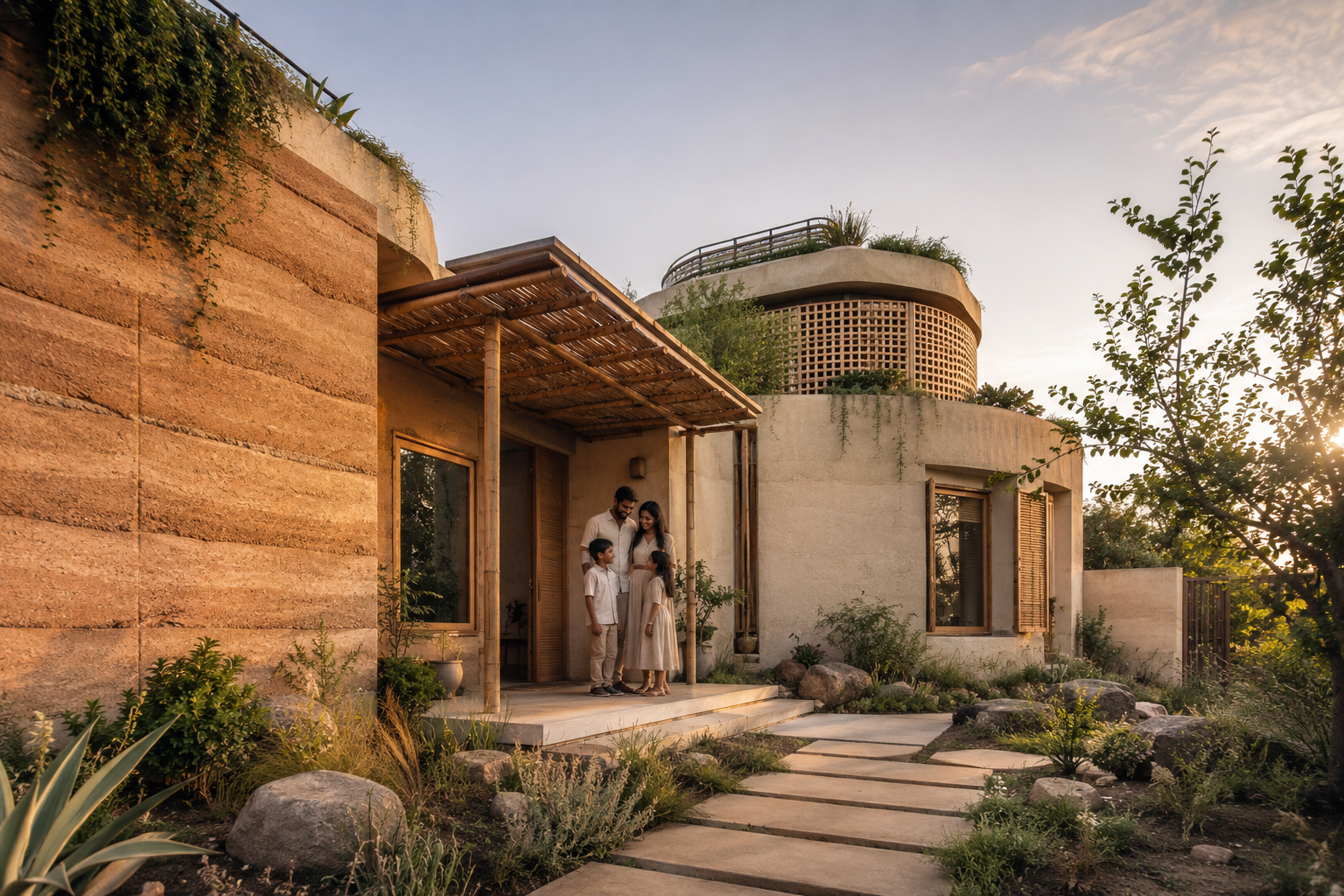
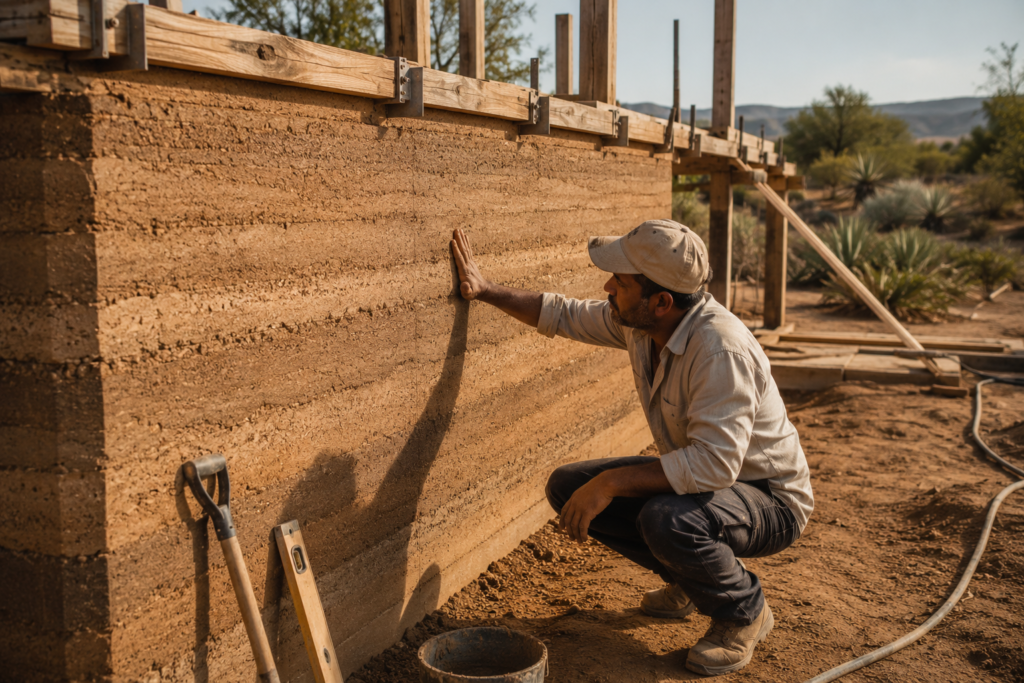
Rammed earth construction compacts moist subsoil mixed with gravel and a small amount of stabiliser (often cement or lime) into formwork, creating walls of extraordinary thermal mass and strength. When stabilised correctly, rammed earth walls are as durable as reinforced concrete and far more beautiful.
Rammed earth is ideal for hot-dry climates: Rajasthan, the Middle East, Central Australia, the American Southwest. The mass absorbs daytime heat and releases it slowly at night, flattening the temperature curve inside the home and dramatically reducing cooling loads. In temperate climates, rammed earth combines well with good insulation strategies.
Auroville in Tamil Nadu has used rammed earth and compressed earth blocks extensively for decades, demonstrating its viability in South Asian conditions. Dozens of award-winning projects across Australia, South Africa, and the American West now use rammed earth as a primary structural and aesthetic material.
Cork: The Quiet Performer
Cork is harvested from the bark of cork oak trees without felling them. The bark regenerates every 9 years, making it one of the most sustainable harvest cycles in forestry. Cork is naturally antimicrobial, fire-resistant, and an excellent thermal and acoustic insulator.
For homeowners, cork works beautifully as flooring, wall tiles, and insulation board. It is soft underfoot, comfortable in both warm and cool climates, and increasingly available in modern, non-traditional aesthetics. Portugal is the world’s largest cork producer, though Mediterranean and Australian suppliers are growing in scale.
⚠️ WARNING: Untreated Bamboo Will Fail
Raw, untreated bamboo is highly vulnerable to insect attack, fungal decay, and UV degradation. Always specify industrially treated or thermally modified bamboo for structural and exterior applications. Check for a Borax treatment process or equivalent certification.
04 Engineered Sustainable Materials
Cross-Laminated Timber (CLT): Mass Timber’s Rise
Cross-Laminated Timber is made by bonding layers of timber boards at perpendicular angles, creating large structural panels with exceptional strength, stiffness, and fire resistance. CLT can replace concrete and steel in floors, walls, and roofs up to 18 storeys in height, demonstrated by projects in Vienna, London, Vancouver, and Melbourne.
CLT stores approximately 0.8 kgCO₂e per kilogram of material rather than emitting it. A CLT home of 150m² stores enough carbon to offset the emissions of the average Indian household for 4–5 years. CLT manufacturing is growing in Australia, New Zealand, Canada, and Europe, with pilot projects now exploring Indian plantation timber as raw material.
For homeowners in cold, temperate, and timber-rich regions, CLT represents the most structurally advanced sustainable building material available today.
📌 CALLOUT: CLT in India
India’s Forest Research Institute and IIT research programmes are actively exploring CLT production from plantation species including eucalyptus and poplar. As domestic production scales, CLT is expected to become commercially viable for Indian residential construction within 5–7 years.
Fly Ash Bricks and Low-Carbon Concrete
Ordinary fired clay bricks are among the most carbon-intensive small-scale building materials. Fly ash bricks replace the clay with fly ash — a byproduct of coal-fired power stations — mixed with lime and sand. No kiln firing is required. Fly ash bricks cure at ambient temperature, consuming 90% less energy than fired clay bricks.
In India, fly ash bricks are now mandated by the Ministry of Environment for construction within 100 kilometres of thermal power plants. They are widely available across most of urban India, often at lower cost than equivalent fired clay products, with equivalent or superior compressive strength.
Supplementary cementitious materials (SCMs) such as ground granulated blast furnace slag (GGBS) and silica fume can replace 30–70% of ordinary cement in concrete mixes, significantly reducing embodied carbon without compromising structural performance.
💡 TIP: Specify Low-Carbon Concrete
For any concrete use in your project, ask your engineer to specify a GGBS-blended or fly ash-blended mix. A 50% cement replacement typically adds minimal cost while reducing embodied carbon by 40–50%.
Sheep Wool and Hemp Insulation
Fibreglass and expanded polystyrene insulation are the default in most markets. Both are derived from fossil fuels or energy-intensive processes, and neither is recyclable at end of life. Sheep wool and hemp insulation offer equivalent thermal performance, superior moisture management, and fully biodegradable end-of-life profiles.
Sheep wool insulation is produced at scale in New Zealand, the UK, and parts of Central Asia. Hemp insulation is available in Europe, Australia, and increasingly in North America. Both materials work particularly well in climates with significant temperature swings — the UK, temperate India, southern Europe, highland Southeast Asia.
Mycelium Composites: The Material Frontier
Mycelium — the root network of fungi — can be grown around agricultural waste (corn husks, straw, sawdust) to produce lightweight, rigid, biodegradable composite panels. Companies including Ecovative Design (USA) and startups across Europe and Asia are scaling mycelium into packaging, furniture, and experimental architectural applications.
⚠️ WARNING: Insulation R-Value Is Not the Whole Story
A high R-value means good thermal resistance, but it says nothing about moisture behaviour, VOC emissions, fire performance, or end-of-life recyclability. Natural insulation materials often outperform synthetic ones across all four criteria.
Mycelium composites are not yet mainstream building materials, but their near-zero embodied carbon, agricultural waste substrate, and fully compostable end of life place them at the frontier of what sustainable construction materials can become.
05 Recycled Materials
Reclaimed Timber: The Story in the Grain
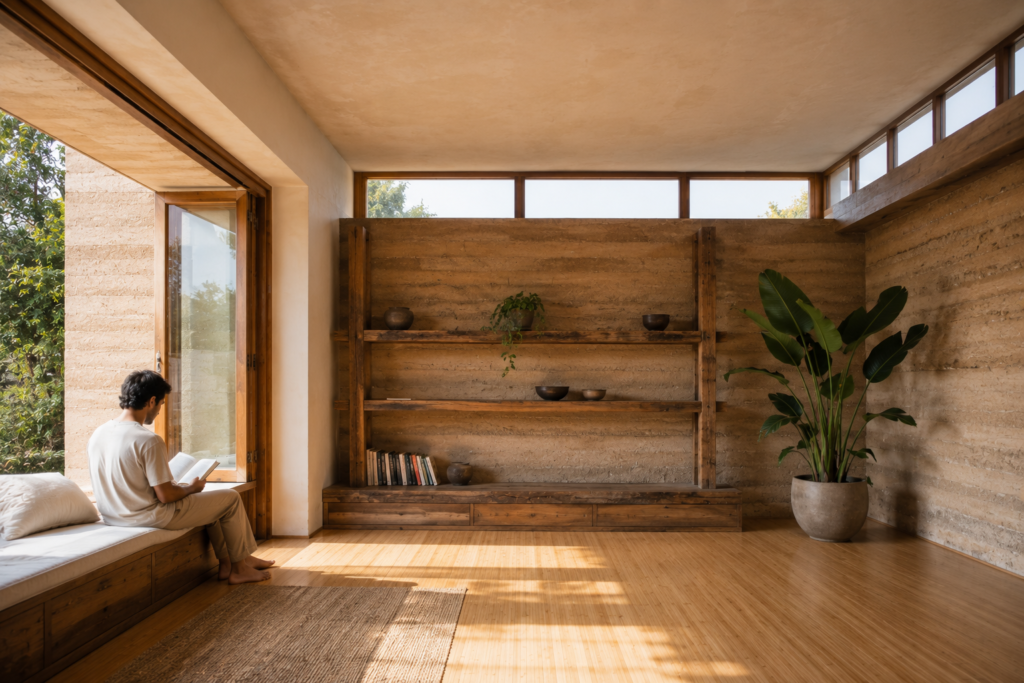
Reclaimed timber is recovered from demolished buildings, old bridges, railway sleepers, wine barrels, and industrial structures. It arrives at your project already cured, already beautiful, and already carbon-neutral — the carbon cost of its original harvest has been amortised over decades or centuries of prior use.
Reclaimed teak, sal, and deodar are widely available through salvage markets across India. Reclaimed Douglas fir, oak, and pine are the dominant species in North American and European markets. For flooring, beams, panelling, and furniture, reclaimed timber is typically more characterful and often more durable than new timber.
📌 CALLOUT: Salvage Markets in India T in India
Cities including Mumbai, Delhi, Bengaluru, Chennai, Kolkata, and Ahmedabad have active salvage markets where reclaimed timber, stone, terracotta tiles, and ironwork can be sourced at prices significantly below new equivalents. Rajasthan offers exceptional antique stone and marble salvage.
Recycled Steel and Repurposed Metal
Steel is one of the most recycled materials on earth — globally, over 85% of structural steel is recycled at end of life. Using recycled steel in construction (which accounts for the majority of commercially available structural steel) reduces embodied carbon by up to 70% compared to virgin production.
Repurposed metal elements — salvaged steel I-beams, corrugated iron roofing, reclaimed copper gutters — add industrial character while eliminating the embodied carbon of new production. Projects in Melbourne, Cape Town, and Mexico City have demonstrated reclaimed steel as a high-design material, not just a budget alternative.
Recycled Glass in Architecture
Crushed glass aggregate can replace sand in concrete mixes, reducing virgin material extraction. Recycled glass tiles, countertops, and terrazzo surfaces use post-consumer glass cullet (bottles, windows, screens) as the primary raw material.
In interior applications, recycled glass surfaces provide beautiful, non-porous, low-maintenance finishes with a fraction of the embodied carbon of equivalent quarried stone or ceramic tile. The material is available from specialist suppliers across the US, Europe, and Australia, with growing availability in South and Southeast Asia.
💡 TIP: Inspect Before You Specify
Reclaimed materials vary in condition. Always inspect reclaimed timber for structural integrity, pest damage, and moisture content before committing to structural use. For decorative use, much wider variation in condition is acceptable.
Recycled Plastic in Construction
Plastic lumber (made from recycled HDPE and PET plastics) is increasingly specified for decking, fencing, external cladding, and structural elements in wet or marine environments. It does not rot, does not require painting, and has a lifespan of 50+ years in most conditions.
Using recycled plastic in construction diverts material from landfill and ocean waste streams. However, it is a genuine building material only when it displaces virgin materials in applications where its performance advantages (water resistance, no maintenance) are relevant. It is not a universal substitute for timber or masonry.
⚠️ WARNING: Lead Paint Risk in Reclaimed Materials
Timber and metal salvaged from pre-1980s buildings in North America, Europe, and Australia may have been coated in lead paint. Test before sanding, cutting, or disturbing. Use an inexpensive lead test kit or commission a laboratory analysis on samples before use.
06 Healthy Interior Materials
The VOC Problem in Interior Finishes
Volatile organic compounds are chemicals that evaporate at room temperature from paints, varnishes, adhesives, sealants, composite wood products, and synthetic flooring. They include formaldehyde, benzene, toluene, and dozens of other compounds, many of which are classified as carcinogens or endocrine disruptors.
The impact is worst in new buildings where materials are off-gassing at peak rates. In air-conditioned homes with limited natural ventilation — the norm across urban India, Southeast Asia, and the Middle East — VOC concentrations can remain dangerously elevated for months or years after construction.
📌 CALLOUT: Indoor Air Quality Certification
WELL Building Standard and BREEAM both include dedicated credits for low-VOC interior materials. In India, the Green Rating for Integrated Habitat Assessment (GRIHA) addresses indoor air quality under its Occupant Comfort and Well-being category.
Low-VOC and Natural Paint Systems
Water-based acrylic paints with low-VOC formulations are now available from most major manufacturers. Look for paints certified to EU Ecolabel, Green Seal (US), or GBCI standards. True zero-VOC paints exist but typically require tinting at point of sale using low-VOC colourants to retain their certification.
Natural paint systems — clay paints, lime washes, milk paints, and chalk-based paints — use mineral pigments and natural binders with essentially zero VOC content. They are breathable, vapour-permeable, and highly compatible with natural wall systems like rammed earth, hempcrete, and lime plaster. Brands including Earthborn (UK), Auro (Germany), and Fresco (India) offer natural paint ranges with strong architectural colour palettes.
💡 TIP: Test Before You Commit
Order material samples and live with them in your actual space for at least two weeks. Check colour under natural and artificial light, check texture underfoot or by touch, and ensure adhesives and installation systems also carry low-VOC certification.
Natural and Recycled Flooring Options
The flooring in a home is one of its highest-embodied-carbon, highest-impact finishes. Common choices — synthetic carpet, vinyl, laminate with formaldehyde binders — contribute significantly to poor indoor air quality.
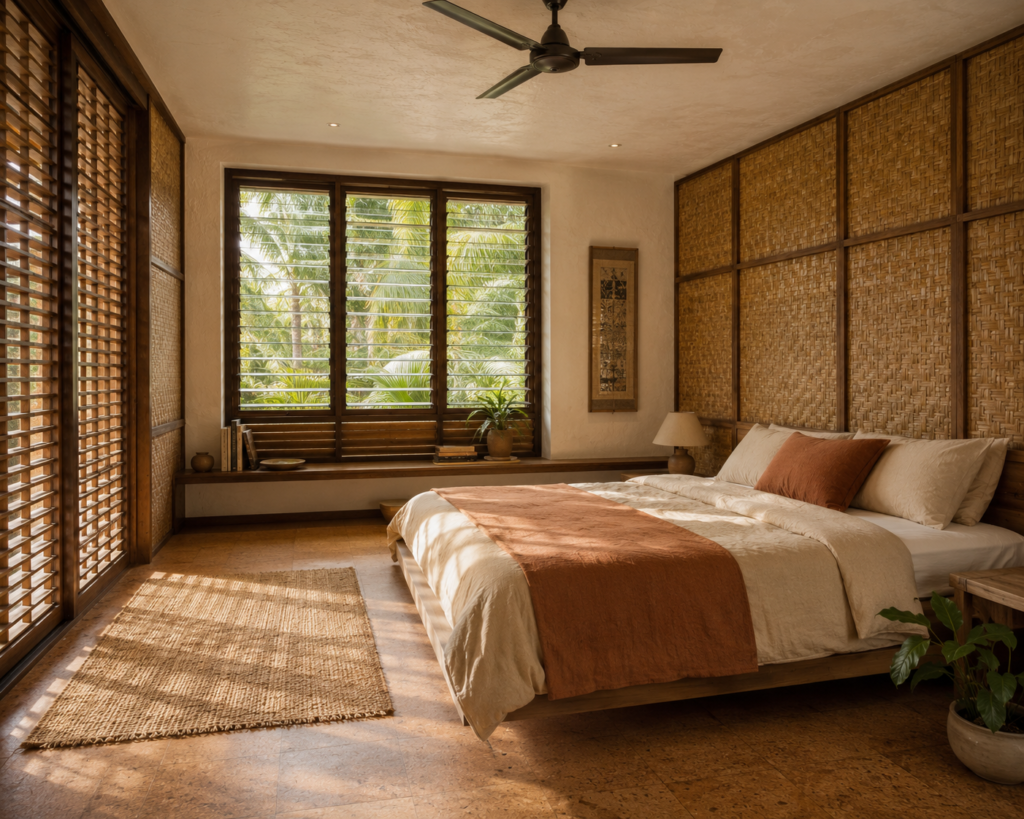
Cork and bamboo flooring are the two highest-performance sustainable alternatives at comparable price points. Both are warm underfoot, acoustically absorbent, durable, and available in contemporary aesthetics. Reclaimed hardwood flooring remains a premium choice with unmatched character and longevity. Stone flooring — particularly locally quarried granite, slate, or sandstone — is low-VOC, extremely durable, and culturally rooted across South Asia, the Middle East, and the Mediterranean.
Lime Plaster and Clay Render
Lime plaster is one of the world’s oldest interior finish systems, used continuously for over 5,000 years. It is vapour-permeable, antimicrobial, durable, and beautiful. As it cures, it re-absorbs CO₂ — making it carbon-negative over time.
⚠️ WARNING: Formaldehyde in Composite Wood
MDF, particleboard, and many laminated products use urea-formaldehyde or phenol-formaldehyde adhesives. These off-gas at elevated rates for 3–5 years. Specify E0 or formaldehyde-free panels (CARB Phase 2 in the US, E1 or better in the EU) for all indoor joinery and furniture.
Clay render (mud plaster) is the traditional finish for rammed earth, adobe, and earthen construction. Modern stabilised clay renders are available as dry mixes from sustainable building suppliers in Australia, Europe, and increasingly in India. Both lime and clay finishes support breathable wall systems that regulate indoor humidity naturally, reducing the need for mechanical dehumidification.
07 Climate-Based Material Selection
Hot-Dry Climates: India, Middle East, Australia Outback
In hot-dry climates, the priority is thermal mass and evaporative cooling. Materials with high thermal mass absorb heat during the day and release it slowly at night, reducing the temperature swing inside the home. This is the principle behind traditional courtyard architecture across Rajasthan, Iran, and Morocco.
Ideal materials: rammed earth, adobe, compressed stabilised earth blocks (CSEB), stone masonry, and mud brick. Thick walls (300–450mm minimum) are essential for effective thermal mass. Whitewashed or light lime-rendered exteriors reflect solar radiation before it can be absorbed.
📌 CALLOUT: Climate-Material Matching Chart
India alone contains 5 distinct Köppen climate zones: tropical (Kw/Aw), semi-arid (BSh), arid (BWh), humid subtropical (Cwa), and highland (H). A material ideal for Jodhpur (arid) may be entirely wrong for Kochi (tropical-humid). Always climate-match before you specify.
Avoid materials that conduct heat rapidly — uninsulated metal roofing, thin concrete slabs, and glass without shading. Trees and vegetation are the most cost-effective thermal management strategy in hot-dry climates.
Hot-Humid Climates: Kerala, Bangladesh, Indonesia, Singapore
Hot-humid climates require the opposite of hot-dry: materials that do not trap heat, allow excellent ventilation, and resist moisture and mould. Thermal mass becomes a liability — walls that absorb heat all day never fully discharge it in warm, humid nights.
Ideal materials: bamboo and timber structures with ventilated walls, fibre-cement cladding, terracotta roof tiles, porous lime or clay renders, and elevated floor platforms. Cross-ventilation is more valuable than insulation in most hot-humid zones.
Moisture management is critical. All materials in contact with ground or exposed to heavy monsoon rain must be specified with appropriate drainage, ventilation, and moisture barriers. Traditional vernacular architecture across Kerala, Bali, and coastal Vietnam evolved precisely these strategies over centuries.
💡 TIP: Use Traditional Vernacular as Your Starting Point
Every regional architecture evolved over centuries to match local climate with locally available materials. Before specifying imported solutions, study what traditional builders in your climate zone used. The answers are usually correct — they simply need updating for modern performance standards.
Temperate Climates: Europe, New Zealand, Northern India Highlands
Temperate climates offer the widest material choice. The challenge is managing both heating in winter and cooling in summer. Insulation becomes critical — sheep wool, hemp, cellulose, or rigid cork board are the highest-performance sustainable options.
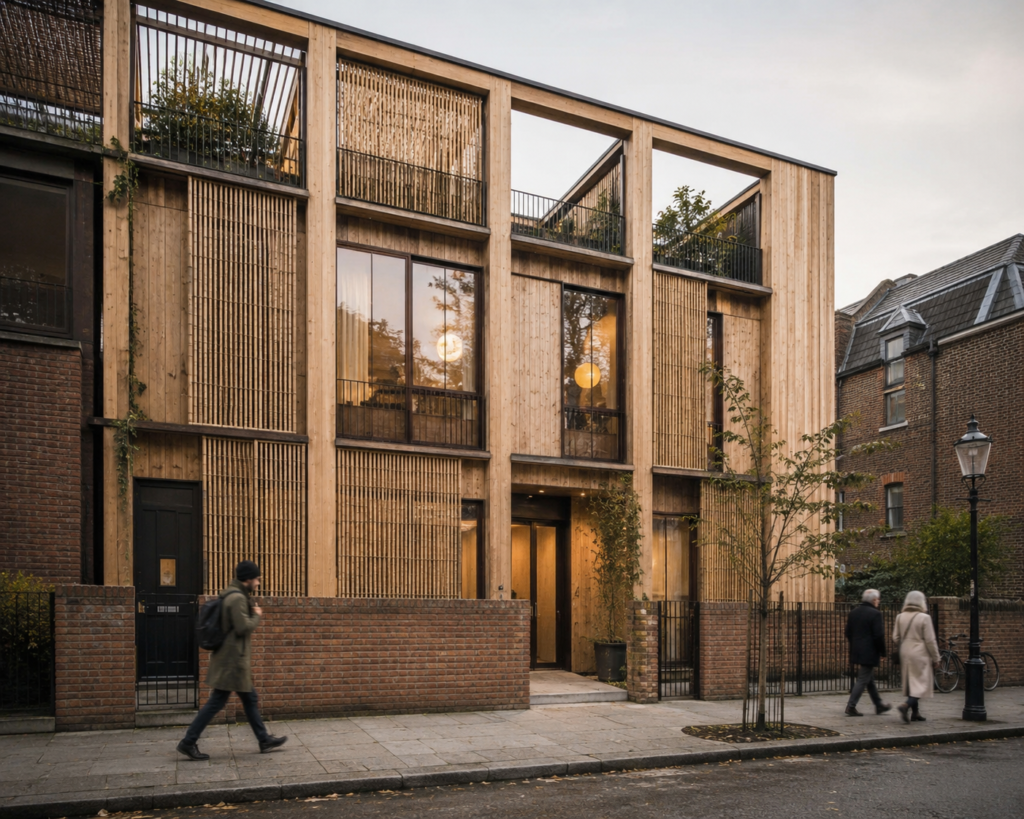
CLT and timber frame construction excel in temperate climates, providing structural efficiency, low embodied carbon, and compatibility with natural insulation systems. Lime render and clay plasters work well as breathable exterior and interior finishes. Green roofs and living walls add insulation, stormwater management, and biodiversity.
Cold Climates: Scandinavia, Canadian Prairies, Himalayan Region
In cold climates, the absolute priority is airtightness and super-insulation. Hempcrete, though not well-suited as a sole insulator in extreme cold, performs well as a hybrid system with additional external insulation board. Timber frame and CLT construction dominate cold-climate sustainable building.
⚠️ WARNING: Do Not Apply Hot-Dry Logic to Hot-Humid
Thick thermal mass walls that perform beautifully in Rajasthan become liabilities in Kerala. Heavy concrete walls in hot-humid climates trap daytime heat and create uncomfortable nighttime conditions. Specify for your actual climate, not a different climate’s best practice.
Passive House (Passivhaus) principles — developed in Germany for cold European climates — are now being adapted globally. A well-designed cold-climate sustainable home uses 90% less heating energy than a conventional equivalent through insulation, airtightness, and heat recovery ventilation.
08 Cost vs. Value
The Real Price of Conventional Materials
The purchase price of a conventional material rarely reflects its true cost. Ordinary concrete, fired clay brick, and synthetic finishes appear inexpensive because their environmental, health, and maintenance costs are externalised — paid by the atmosphere, future generations, and your own health budget rather than appearing on the builder’s invoice.
When you factor in the full cost of a material — upfront price, maintenance, energy performance, health impact, and end-of-life disposal — the premium for sustainable alternatives often disappears or reverses entirely.
📌 CALLOUT: The Value Calculation
A study by RICS (Royal Institution of Chartered Surveyors) found that green-certified residential buildings achieve 5–16% value premiums over equivalent non-certified buildings globally. In Indian commercial real estate, LEED-certified buildings command 10–17% rental premium according to JLL India research.
Where Sustainable Materials Are Already Cost-Competitive
Fly ash bricks in India are price-competitive with fired clay bricks in most markets and available at lower cost in states with large thermal power capacity. Bamboo flooring is competitive with engineered timber at the mid-range price point. Reclaimed stone and timber are often less expensive than equivalent new materials when sourced through salvage markets.
Lime and clay renders require comparable skill to cement render but significantly less energy-intensive materials. Cork insulation board is price-competitive with EPS (expanded polystyrene) in Europe and Australia. The cost premium for sustainable materials has narrowed substantially in the last decade and continues to fall as supply chains scale.
💡 TIP: Calculate the 30-Year Cost
For any significant material choice, build a simple spreadsheet comparing: (1) upfront cost, (2) annual maintenance cost × 30 years, (3) energy cost impact × 30 years, (4) residual value at year 30. Natural and sustainable materials consistently win this calculation.
Where to Expect a Premium — and Why It Is Worth It
CLT timber commands a 15–30% premium over reinforced concrete construction in most markets, though this gap is closing. Certified organic or natural paint systems cost 10–30% more than synthetic equivalents. Hemp insulation carries a 20–40% premium over fibreglass in most markets.
These premiums typically yield returns through reduced energy bills, lower maintenance costs, and improved occupant health outcomes. A building certified to GRIHA 4–5 star or LEED Gold in India typically achieves 5–10% rental premium and significantly faster resale. The investment case for sustainable materials is increasingly compelling.
Financing and Incentives
Green home loans are now available from several major Indian banks and NBFCs including SBI, HDFC, and Axis Bank, offering preferential rates for GRIHA or IGBC-certified projects. The Reserve Bank of India’s priority sector lending guidelines now support green housing finance.
⚠️ WARNING: Do Not Greenwash Your Budget
Some sustainable material quotes include premium delivery, speciality installation teams, or imported certifications that add cost without adding performance. Source locally where possible, build relationships with local sustainable material suppliers, and challenge any line item you do not understand.
In Australia, the Clean Energy Finance Corporation provides low-cost finance for energy-efficient homes. In the UK, the Green Homes Grant and local authority schemes support insulation and renewable energy upgrades. In the US, the Inflation Reduction Act provides tax credits for energy-efficient improvements. Always investigate local incentives before finalising your material budget.
09 Common Material Mistakes
Mistake 1: Specifying Materials Without Climate Research
The most costly material mistake is specifying a material — however sustainable in principle — without understanding how it performs in your specific climate. Hempcrete in a monsoon zone without adequate lime render protection will absorb moisture and degrade. Rammed earth in a high-rainfall zone without roof overhangs and proper drainage will erode. Match your material to your microclimate first.
📌 CALLOUT: The Most Common Mistake in India
Specifying fly ash bricks without confirming the source and quality certification is the most common sustainable material mistake in Indian residential construction. Quality varies significantly between manufacturers. Always request IS 12894 certification and ask for third-party compressive strength test results.
Mistake 2: Prioritising Aesthetics Over Performance
Sustainable materials have become fashionable. Exposed rammed earth, raw bamboo, and whitewashed lime plaster look beautiful in architecture photography. But aesthetic choices made without understanding the maintenance requirements, climate performance, or long-term behaviour of a material lead to expensive regret.
A bamboo ceiling in a humid interior without sealed joints and adequate ventilation will develop mould within two monsoon seasons. Understand the performance of a material before its appearance.
💡 TIP: Create a Material Passport
For every significant material used in your project, maintain a simple record: manufacturer, batch, installation date, maintenance schedule, and performance data. This is your home’s material passport — invaluable for maintenance planning, insurance, and future resale.
Mistake 3: Ignoring the Material Transition Zone
Where two materials meet — timber meeting concrete, lime render meeting aluminium window frames, bamboo meeting steel connections — is where most building failures occur. Sustainable materials often have different coefficients of thermal expansion and different moisture behaviour than the conventional materials they adjoin. Design and detail these transitions carefully, and specify compatible sealants and flashings.
Mistake 4: Overlooking Supplier Verification
The sustainable building materials market is growing rapidly, which means greenwashing is also growing. ‘Eco bamboo’, ‘green concrete’, and ‘sustainable composites’ are marketing terms, not standards. Always request third-party verification: Environmental Product Declarations (EPDs), Forest Stewardship Council (FSC) certification for timber, and recognised green building rating system documentation.
Mistake 5: Skipping the Maintenance Plan
Sustainable materials often require different maintenance routines than conventional ones. Lime render needs re-coating every 5–7 years. Untreated bamboo needs annual inspection and seal coat. Reclaimed timber needs moisture monitoring in humid climates. These are not burdensome requirements — but they must be planned, budgeted, and understood before specification.
⚠️ WARNING: Never Use Sustainable Materials as an Afterthought
Retrofitting sustainable materials into a conventionally designed home is inefficient and expensive. Sustainable material choices are most effective when integrated into the design from the beginning — informing the structural system, the facade strategy, and the spatial layout.
Material Selection Checklist
The Material Selection Pyramid
Use this hierarchy to evaluate every material decision. Move down the pyramid only when a higher-level option is unavailable or unsuitable for your specific context:
| 🌱 Level 1 — Local Natural Materials Rammed earth, locally harvested bamboo, stone, clay, lime — zero or negative embodied carbon, maximum climate compatibility. |
| ♻️ Level 2 — Reclaimed & Recycled Reclaimed timber, recycled steel, salvaged stone, recycled glass — embodied carbon already spent, character and durability proven. |
| 🌾 Level 3 — Renewable Engineered CLT, engineered bamboo, hemp insulation, fly ash bricks — low embodied carbon, industrial performance, growing availability. |
| ⚙️ Level 4 — Certified Low-Carbon Low-carbon concrete mixes, GGBS cement, FSC timber, low-VOC finishes — reduced but not eliminated carbon impact, certified performance. |
| ⚠️ Level 5 — Conventional (Last Resort) Standard Portland cement, virgin steel, fired clay brick, synthetic finishes — use only where no higher-level alternative is technically viable. |
📌 CALLOUT: One Decision, Many Criteria
No single material will score perfectly across all criteria. The goal is to make the best available choice given your climate, budget, and project type — and to document your reasoning so future decisions can build on it.
Full Material Comparison Table
Use this table to compare the 12 key sustainable materials covered in this guide across all critical dimensions:
| Material | Embodied Carbon | Durability | Cost | Best Climate | Avg. Lifespan |
| Bamboo | Very Low | High | Low-Med | Tropical / Humid | 25–50 yrs |
| Hempcrete | Net Zero | High | Medium | Temperate / Dry | 100+ yrs |
| Rammed Earth | Very Low | Very High | Low-Med | Hot-Dry / Arid | 500+ yrs |
| Reclaimed Wood | Very Low | High | Variable | All Climates | 50–100 yrs |
| Cork | Negative | Medium | Medium | Temperate / Med. | 25–40 yrs |
| Mycelium | Very Low | Low-Med | Low | All (Interior) | 10–30 yrs |
| Recycled Steel | Low | Very High | Medium | All Climates | 100+ yrs |
| Fly Ash Brick | Low | High | Low | Hot-Humid / Dry | 50–75 yrs |
| CLT Timber | Low-Carbon | High | Med-High | Temperate / Cold | 75–150 yrs |
| Adobe | Very Low | Medium | Very Low | Hot-Dry | 100+ yrs |
| Recycled Glass | Low | High | Med-High | All (Interior/Ext.) | 50–100 yrs |
| Lime Plaster | Low | High | Low | All Climates | 50–100 yrs |
Maintenance Matrix
Plan your long-term material maintenance using this matrix. Factor these costs and time requirements into your material selection decision:
| Material | Frequency | What to Check | DIY Friendly? | Annual Cost Est. |
| Bamboo | Annually | Seal coat, joints | Yes | $50–150 |
| Hempcrete | Every 5 yrs | Lime render, cracks | Partially | $80–200 |
| Rammed Earth | Every 5 yrs | Erosion, surface seal | Yes | $30–100 |
| Reclaimed Wood | Every 2 yrs | Finish coat, warping | Yes | $100–300 |
| Recycled Steel | Every 3–5 yrs | Rust checks, paint coat | Partially | $50–200 |
| CLT Timber | Every 3 yrs | Moisture, finish | Partially | $100–250 |
| Lime Plaster | Every 5 yrs | Cracks, re-coat | Yes | $40–120 |
💡 TIP: Build a Material Library
Before your project begins, collect physical samples of your shortlisted materials. A small library of samples — held in your hand, placed in your actual space, examined in real light — will tell you more than any specification sheet.
Your Personal Material Selection Checklist
Run every material through this checklist before finalising your specification:
- Is this material appropriate for my specific climate zone?
- What is the documented embodied carbon (EPD or ICE database reference)?
- Can this material be sourced within 500km of my project?
- Is there third-party certification for this material’s sustainability claims?
- What is the realistic lifespan under my climate and use conditions?
- What is the maintenance requirement and annual maintenance cost estimate?
- Does this material contribute to healthy indoor air quality (low VOC, breathable)?
- What happens to this material at end of life — can it be recycled, reused, or composted?
- Has this material been used successfully in similar climates in similar applications?
- Do I have access to a builder or contractor with demonstrated experience installing this material?
⚠️ WARNING: Do Not Finalise Materials Without Contractor Verification
The best material choice on paper becomes a liability if your contractor has never installed it. Confirm installer experience and availability for every non-conventional material before it appears in your specification.
30-Day Action Plan: Your Sustainable Materials Roadmap
Use this structured four-week plan to move from awareness to action. Each week builds on the last, ending with a clear, costed roadmap for your sustainable home.
| Week 1 Audit Your Materials | Walk through your home and photograph all existing materials.List materials by room — walls, floors, ceiling, fixtures.Research the embodied carbon of your top 5 materials.Note which materials show wear, toxins, or inefficiency.Download the ARCNET Sustainable Materials Comparison Guide. |
| Week 2 Identify Sustainable Alternatives | For each flagged material, research one sustainable swap.Check local availability of bamboo, hempcrete, or reclaimed wood.Request quotes from 2–3 sustainable material suppliers.Compare embodied carbon of old vs. new materials.Build a shortlist of 3–5 preferred replacement materials. |
| Week 3 Prioritise Healthy Interior Materials | Audit interior paints, adhesives, and sealants for VOC content.Replace high-VOC products with low-VOC or natural alternatives.Research natural flooring: cork, reclaimed timber, bamboo.Check insulation type — replace fiberglass with sheep wool or hemp.Order samples and test swatches in your actual lighting conditions. |
| Week 4 Build Your Long-Term Roadmap | Rank renovation projects by impact: structure first, finishes last.Set a 12-month budget for the highest-priority material swap.Find a local architect or builder familiar with green materials.Create a material maintenance schedule using the Maintenance Matrix.Share your roadmap with your household and commit to one action. |
Key Takeaways
Sustainable materials reduce both embodied carbon and operational energy — choosing the right ones matters from day one.
Natural materials like bamboo, hempcrete, and rammed earth outperform concrete in carbon impact and longevity.
Embodied carbon — the carbon locked into your materials before your home is even lived in — is the biggest overlooked factor in home sustainability.
Climate-matching is critical: a material excellent in hot-dry Rajasthan may perform poorly in humid Kerala or cold Himachal.
Recycled and reclaimed materials often cost less upfront while delivering equivalent or superior durability.
Healthy interior materials — low-VOC paints, natural flooring, lime plaster — directly improve indoor air quality and long-term wellness.
The 30-Day Action Plan gives you a structured framework to audit, research, prioritise, and build your long-term materials roadmap.
The 30-Day Action Plan gives you a structured framework to audit, research, prioritise, and build your long-term materials roadmap.
The true cost of a material includes maintenance, health impact, climate performance and end-of-life recyclability — not just purchase price.
Frequently Asked Questions
| Q1: Are sustainable materials available across India? |
| Yes. Fly ash bricks are widely available across most Indian states and mandated near thermal power plants. Bamboo is commercially produced in Assam, Tripura, Meghalaya, Karnataka, and Odisha. Lime is available nationally. Compressed stabilised earth blocks are produced by AUROVILLE Earth Institute in Tamil Nadu and several manufacturers in Karnataka, Maharashtra, and Rajasthan. Reclaimed stone, timber, and terracotta are available through salvage markets in most major cities. Availability of hemp and CLT is growing, with specialist suppliers operating in major urban centres. |
| Q2: Do sustainable materials cost more than conventional ones? |
| Not always, and not in whole-life terms. Fly ash bricks are typically cost-competitive with fired clay in India. Rammed earth has higher labour costs but near-zero material cost when soil is available on-site. Reclaimed materials are often less expensive than new equivalents when sourced locally. Premium sustainable materials like CLT, hemp insulation, and natural paint systems do carry upfront premiums of 10–40%, but these are typically recovered through reduced energy costs, lower maintenance, and improved health outcomes over a 20–30 year horizon. |
| Q3: What is the most sustainable material I can use for a home in a hot-humid climate like Kerala? |
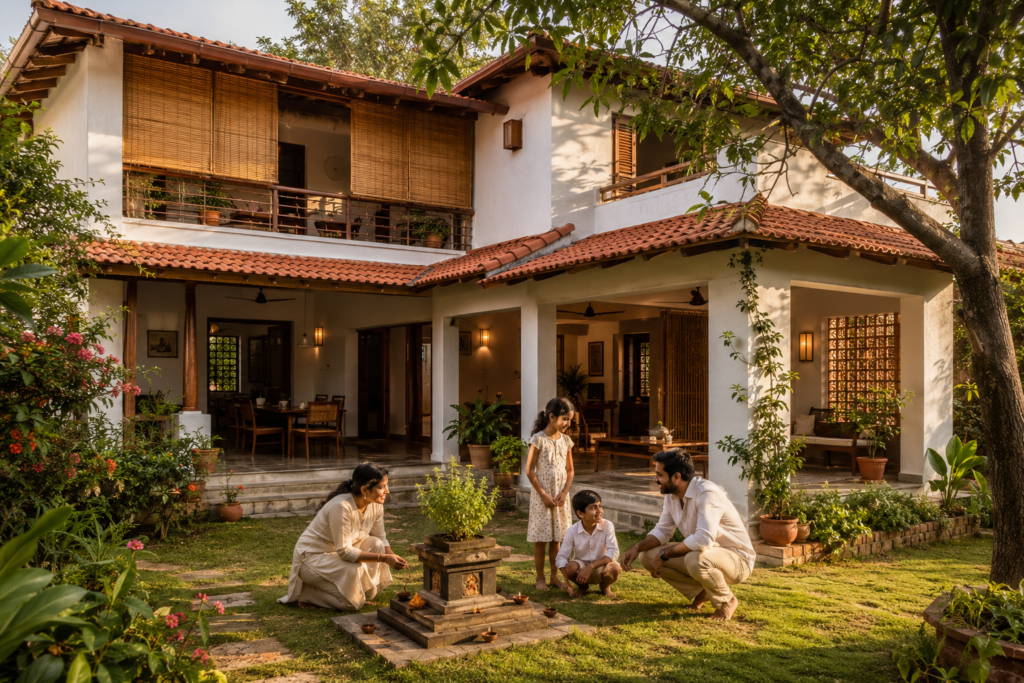
| In a hot-humid climate, bamboo and local timber are the highest-performance sustainable structural materials. They are lightweight, do not retain heat, and are climatically appropriate. Terracotta roof tiles, lime or clay render, and porous brick or laterite stone walls (traditional to Kerala) all perform excellently. The priority is ventilation and moisture management over thermal mass or heavy insulation. Traditional Kerala vernacular architecture — with its steep pitched roofs, wide overhangs, and cross-ventilated open plans — embodies exactly the right material and design logic for the climate. |
| Q4: How do I verify that a material’s sustainability claims are genuine? |
| Request an Environmental Product Declaration (EPD) — a verified, third-party life cycle assessment of the material’s environmental impact. For timber and wood products, look for FSC or PEFC certification. For building materials in India, check for Bureau of Indian Standards (BIS) certification and, where applicable, GRIHA or IGBC product endorsement. For paints and finishes, look for EU Ecolabel, Green Seal (US), or equivalent certifications. If a supplier cannot provide documentary evidence for their sustainability claims, treat those claims with significant scepticism. |
| Q5: Is hempcrete available in India? |
| Hemp cultivation was legalised for industrial purposes in several Indian states including Uttarakhand, Himachal Pradesh, and Jammu and Kashmir in recent years. Small-scale hempcrete production and demonstration projects are underway, particularly in the Himalayan region. Commercially scaled hempcrete is not yet widely available across India, but specialist builders in Pune, Bengaluru, and Delhi have completed hempcrete projects using lime and hemp shiv sourced domestically or from Nepal. The market is growing rapidly. |
| Q6: What are the best sustainable flooring options for Indian homes? |
| Locally quarried natural stone — granite, sandstone, slate, Kota stone, Shahabad limestone — is the gold standard for sustainable flooring in India. It has very low embodied carbon when locally sourced, exceptional durability, and is culturally rooted across all Indian regions. Bamboo flooring is an excellent alternative for rooms requiring warmth underfoot. Terracotta tiles are a traditional, sustainable, and beautiful option for living areas and verandahs. Reclaimed timber is appropriate for bedrooms and study spaces. Avoid vinyl, synthetic carpet, and laminate flooring with formaldehyde binders. |
| Q7: How do I start if I am mid-renovation and cannot change the structure? |
| Start with what you can control: finishes, paints, flooring, furniture, and fittings. Replace synthetic paints with low-VOC or natural paint systems. Swap synthetic carpet for cork, bamboo, or reclaimed timber flooring. Replace formaldehyde-heavy MDF joinery with solid wood or E0-rated panels. Use lime wash or clay render over existing plaster in at least one key room. These changes dramatically improve indoor air quality and begin building your sustainable material knowledge without requiring structural intervention. |
| Q8: Where can I find architects and builders experienced with sustainable materials in India? |
| The Indian Green Building Council (IGBC) maintains a directory of accredited professionals. The Council for Green Buildings and Sustainable Cities (CGBSC) and GRIHA Council both list experienced practitioners. Architecture schools at CEPT University (Ahmedabad), SPA Delhi, and Kamla Raheja Institute Mumbai have produced many architects specialising in sustainable and vernacular construction. Auroville (Tamil Nadu) has a globally respected community of sustainable building practitioners. ARCNET maintains a curated directory of sustainable architecture professionals across India and the wider region. |
Downloadable PDF Resource Structure
Continue Exploring
This article is part of the ARCNET.STUDIO Sustainable Homes Content Cluster. Deepen your knowledge with these related guides:
| 🌬️ Passive Design Strategies How building orientation, shading, and natural ventilation reduce energy use without mechanical systems. | 🌿 Wellness Architecture Design principles for homes that actively improve physical and mental health for their occupants. | 🧱 Hempcrete vs Concrete A detailed comparison of hempcrete and ordinary concrete across cost, carbon, durability, and climate performance. |