Midjourney Prompt Formula for Architects:
Build Better Architectural Visuals
Why This Matters
AI image tools like Midjourney have changed how architects communicate ideas. What used to take days in Photoshop or a rendering farm can now take minutes. But there’s a catch.
Most architects get weak, generic results — not because Midjourney is limited, but because their prompts are vague. Midjourney does not read your mind. It reads your words.
This guide gives you a structured formula to write Midjourney prompts for architects that are precise, visual, and consistently professional. Whether you’re designing a residence in India, a commercial block in Singapore, or a cultural centre in Dubai — the formula works.
✅ TIP
The difference between a bad Midjourney output and a stunning one is rarely the tool. It’s almost always the prompt. Treat your prompt like a design brief.
Who Is This Guide For?
🎓
Architecture Students
You need to present design concepts fast. This formula helps you create photorealistic renders without software training or a rendering budget.
🏛️
Practising Architects
You want to show clients compelling visuals before expensive renders. Use this system to speed up concept-stage presentations.
📐
Interior Designers
You need material mood boards, furniture compositions, and room renders. The prompt builder section is made for your workflow.
🖥️
Architecture Content Creators
You produce videos, carousels, and blog posts. This system gives you a repeatable visual language for consistent, high-quality content.
Quick Navigation
| 01 The Prompt Formula Framework Learn the 8-part formula that turns vague ideas into precise architectural visuals. | 02 Style Matrix for Architecture Choose the right architectural style and mood modifiers for your project. |
| 03 Camera & Lens Guide Pick the right virtual lens to control perspective, drama, and composition. | 04 Lighting & Atmosphere Master lighting conditions that make renders look cinematic and professional. |
| 05 Material & Climate Modifiers Add regional materials and climate-responsive textures to ground your renders in reality. | 06 Prompt Builder System Use our slot-based builder to assemble production-ready prompts in under 2 minutes. |
Quick Wins Checklist
Before you start, make sure you can check all of these:
☐ I have a Midjourney account and access to Discord or the Midjourney web app
☐ I know the building type or space I want to visualise
☐ I have a rough style reference in mind (e.g., modern, tropical, brutalist)
☐ I understand that a longer, more specific prompt usually outperforms a short one
☐ I am ready to iterate — good Midjourney prompts are refined, not written once
☐ I have noted my target climate or region for accurate material choices
☐ I have read at least one reference image that inspires this project
01 .The Prompt Formula Framework
Midjourney prompts for architects work best when they follow a consistent structure. Random descriptions produce random results. A formula produces repeatable, professional quality.
The ARCNET.STUDIO Prompt Formula breaks every architectural prompt into eight components. Together they tell Midjourney exactly what to render, how to light it, what camera to use, and what mood to create.
The 8-Part Formula
| COMPONENT | WHAT IT DOES | EXAMPLE |
| Subject | Names the building or space | a contemporary urban apartment tower |
| Architectural Style | Sets visual language | brutalist, exposed concrete, raw texture |
| Setting / Context | Defines surroundings | dense Mumbai streetscape, evening, monsoon |
| Lighting | Controls mood and time of day | golden hour, soft ambient, dramatic shadows |
| Camera / Lens | Defines perspective and framing | wide-angle 28mm, eye-level, architectural photography |
| Materials | Specifies surfaces and finishes | board-formed concrete, weathered steel, dark glass |
| Mood / Atmosphere | Sets emotional tone | urban, gritty, monumental, contemplative |
| Render Parameters | Controls output quality | –ar 16:9 –style raw –q 2 –v 6 |
📌 FORMULA EXAMPLE
A brutalist community library in a dense Chennai neighbourhood, exposed board-formed concrete facade, monsoon rain, street-level view, 28mm wide-angle, dramatic overcast light, dark reflective puddles, cinematic, hyperrealistic architectural photography –ar 16:9 –style raw –q 2 –v 6
Why Order Matters
Midjourney reads prompts from left to right and weights earlier words more heavily. Put your most important information — subject, style, setting — first. Render parameters always go last.
✅ TIP
Write your subject in 5–8 words, then add modifiers. If your subject is unclear in the first line, the rest of the prompt cannot save it.
Common Formula Mistakes
- Using only 1–2 components and expecting professional output
- Placing lighting or mood before the subject
- Using contradictory styles in the same prompt (e.g., ‘minimalist brutalist maximalist’)
- Forgetting the render parameters — they control aspect ratio and quality
⚠️ WARNING
Never use contradictory style labels in a single prompt. Midjourney will average them into a confused result. Pick one dominant style, then add 2–3 supporting modifiers.
Formula for Different Building Types
The formula adapts to any project. For interiors, replace ‘setting’ with room type and size. For urban design, replace ‘subject’ with streetscape or masterplan view. For landscape architecture, add vegetation density and water features to the materials slot.
02 . Style Matrix for Architecture
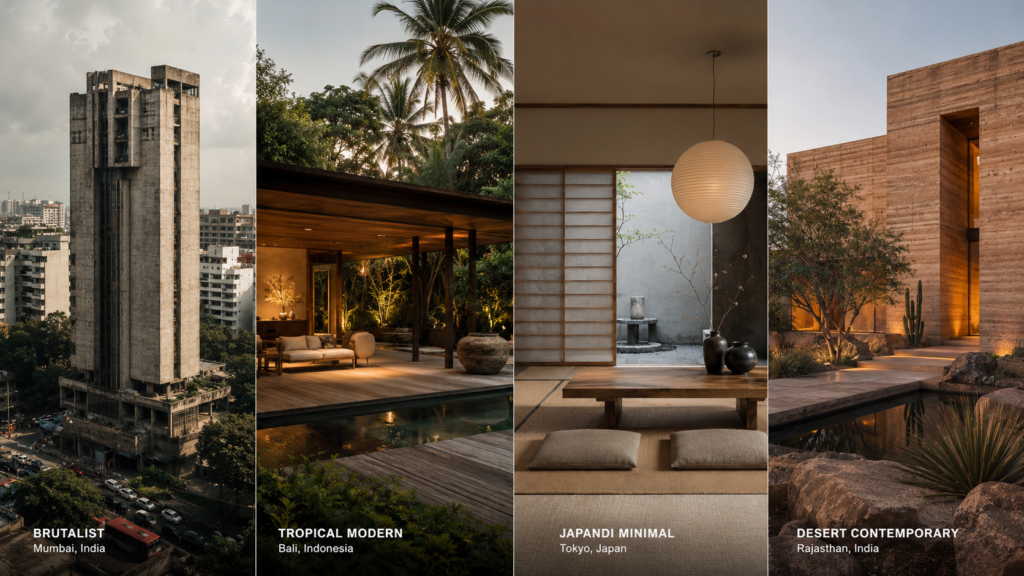
Architectural style is the most powerful component in your prompt. It immediately sets expectations for form, material, proportion, and detail. The ARCNET Style Matrix maps 8 core styles to moods, building types, and key modifiers.
The Style Matrix
| STYLE | MOOD | BEST FOR | KEY MODIFIERS |
| Brutalist | Raw, bold, urban | Urban housing, cultural buildings | exposed concrete, monolithic, textured |
| Japandi | Calm, minimal, warm | Residential interiors, small homes | natural wood, wabi-sabi, neutral palette |
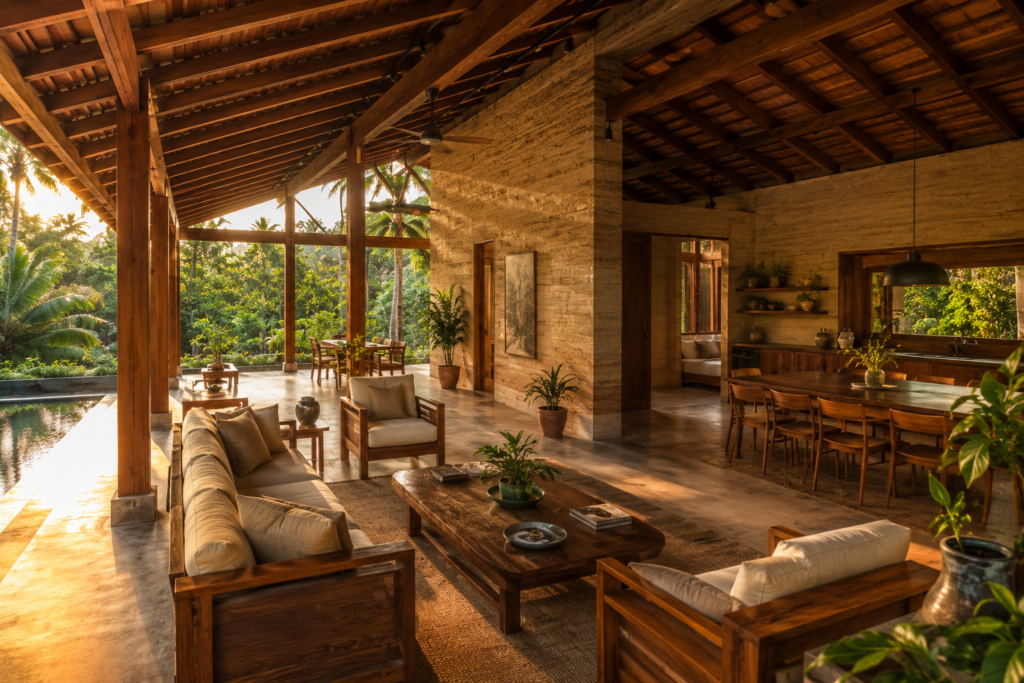
| Tropical Modern | Lush, open, breezy | Southeast Asian homes, resorts | open pavilion, green wall, rain screen |
| Desert Contemporary | Earthy, low-profile, warm | Middle East, India dry zones | rammed earth, terracotta, shade pergola |
| Scandinavian | Clean, light, functional | Temperate climates, apartments | white walls, birch, minimalist detail |
| Mediterranean | Warm, textured, organic | Southern Europe, coastal homes | lime plaster, terracotta tile, arched openings |
| High-Tech | Sleek, metallic, futuristic | Commercial, luxury residential | glass curtain wall, steel frame, LED facade |
| Vernacular | Local, cultural, contextual | Rural India, Asia, heritage zones | local stone, pitched roof, verandah |
📌 GOOD STYLE MIX EXAMPLE
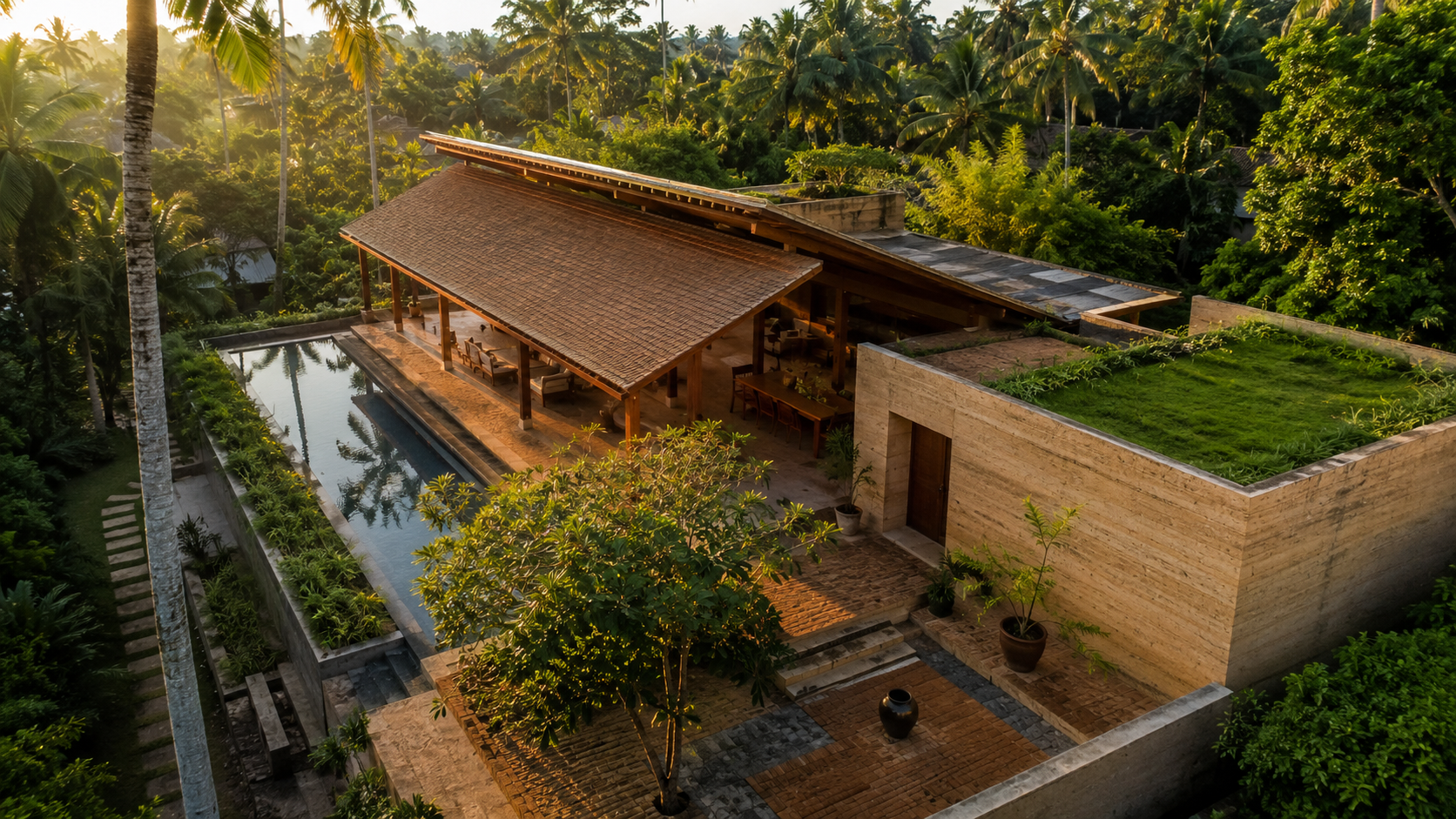
A contemporary residence with tropical modern massing and Kerala vernacular roof forms, open plan, natural ventilation, exposed timber rafters, lime-washed walls, lush courtyard, golden hour –ar 16:9 –style raw –q 2
Mixing Styles — When to Do It
Mixing styles is possible, but requires care. The safest combinations pair a dominant style with a regional vernacular influence. For example: ‘tropical modern with Kerala vernacular influences’ or ‘Scandinavian minimalism with Japanese wabi-sabi detailing.’
⚠️ WARNING
Avoid stacking more than two architectural styles. Three or more styles produce incoherent renders that look like a design accident, not a design choice.
Style Parameters for Midjourney v6
In Midjourney v6, the –style parameter significantly changes output character. Use –style raw for architectural photography realism. Avoid –style cute or –style expressive for professional architecture work.
- –style raw → best for photorealistic architectural renders
- –style scenic → good for environmental / landscape projects
- No –style flag → Midjourney applies its default aesthetic, which is often over-stylised for architecture
✅ TIP
Save your favourite style combinations as text snippets. A good style block — like ‘tropical modern, open pavilion, lush green, rammed earth, –style raw’ — can be reused across dozens of projects.
Regional Style Considerations
Architecture visuals need to feel grounded. An Indian client reviewing a house design wants to see materials, vegetation, and light that match their climate and culture — not a generic European render. Use the style matrix to choose regionally appropriate modifiers.
03 .Camera & Lens Guide
In Midjourney, ‘camera angle’ and ‘lens type’ are the most underused prompt components. They control perspective, spatial feel, and how dramatic your render looks. Architects who understand camera language produce consistently better visuals.
The ARCNET.STUDIO Camera Lens Guide
| LENS | FOCAL LENGTH | EFFECT IN ARCH | BEST USE |
| Ultra-Wide | 14–24mm | Dramatic perspective, exaggerated depth | Interior spaces, grand facades |
| Wide | 28–35mm | Natural perspective, slight drama | Residential exteriors, streetscapes |
| Standard | 50mm | Human-eye view, balanced proportion | Lifestyle shots, room interiors |
| Portrait | 85mm | Slight compression, elegant detail | Facade details, furniture close-ups |
| Telephoto | 135–200mm | Strong compression, layered planes | Skylines, urban density shots |
| Drone / Aerial | Equivalent 20–28mm | Top-down, master planning scale | Site plans, landscaping, urban context |
✅ TIP
If your render feels flat or uninspiring, change the camera angle first. A simple switch from eye-level to low-angle 24mm can transform a boring facade into a dramatic composition.
Camera Angle Keywords
Lens type alone is not enough. You also need to specify the angle. Midjourney responds well to these terms:
- eye-level — standard human perspective, feels natural and relatable
- low-angle / worm’s eye — makes the building feel monumental and powerful
- high-angle / bird’s eye — shows site layout, roofscape, and massing
- 3/4 view — the most common architectural presentation angle
- interior perspective — looking into a room from a corner or doorway
📌 CAMERA + LENS EXAMPLE Low-angle 24mm ultra-wide view of a brutalist concrete cultural centre in Chandigarh, dramatic overcast sky, strong shadows, hyperrealistic architectural photography, extreme perspective depth –ar 16:9 –style raw –q 2
Drone and Aerial Prompts
Aerial views are increasingly valuable for masterplan presentations, landscape architecture, and urban design projects. Use these modifiers for convincing drone shots.
- aerial view, drone photography, 100m altitude
- top-down orthographic view, site plan perspective
- oblique aerial, 45-degree angle, urban context visible
⚠️ WARNING
Avoid using ‘fisheye lens’ for architectural work. It distorts straight lines severely and makes buildings look warped and unprofessional in most contexts.
Camera + Style Combinations That Work
The best renders pair a camera type with a matching architectural style. Ultra-wide angles suit brutalist and high-tech styles. Standard 50mm works best for residential Japandi or Scandinavian projects. Telephoto compression suits skylines and layered urban density studies.
04. Lighting & Atmosphere
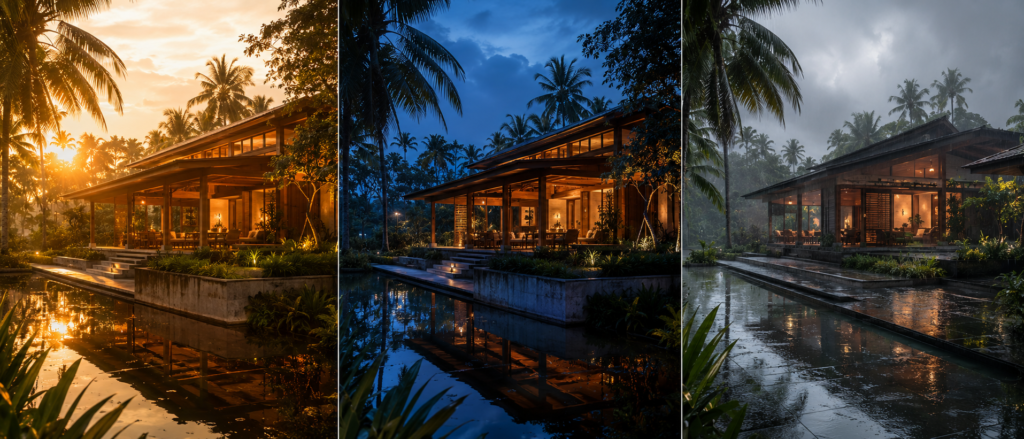
Lighting is the fastest way to transform a Midjourney render from competent to cinematic. The same building can look completely different at dawn versus dusk, in harsh midday sun versus soft overcast light.
Core Lighting Conditions for Architecture
- Golden Hour — warm amber light, long shadows, most flattering for residential
- Blue Hour / Dusk — deep blue sky, warm interior glow from inside, dramatic contrast
- Overcast / Diffused — even, shadowless light, best for showing material textures
- Harsh Midday — high contrast, strong shadows, suits brutalism and desert projects
- Night / Artificial Light — glowing interiors, facade lighting, dramatic and theatrical
- Monsoon / Rainy — reflective puddles, moody grey sky, Southeast Asian and Indian vernacular
📌 LIGHTING EXAMPLE A contemporary Indian courtyard house at blue hour dusk, warm amber light glowing from within the open courtyard, deep blue sky above, lime-washed walls, reflection in shallow water feature, cinematic, hyperrealistic –ar 16:9 –style raw –q 2
Atmosphere Modifiers
Beyond time of day, add weather and atmosphere to deepen the mood:
- morning mist — soft, ethereal, good for landscape and resort projects
- desert heat haze — shimmer effect, suits Middle East and Rajasthan projects
- tropical humidity — lush, green, diffused light filter
- urban smog / pollution haze — adds gritty realism to city renders
- snow and frost — Scandinavian and high-altitude projects
✅ TIP
Always name both the time of day AND a secondary atmosphere modifier. ‘Golden hour’ is good. ‘Golden hour with light morning mist and damp stone’ is cinematic.
Lighting for Interior Renders
Interior lighting in Midjourney works differently from exterior. Focus on:
- natural light from windows — ‘morning sunlight streaming through floor-to-ceiling glass’
- artificial warm light — ‘warm recessed lighting, amber glow, evening’
- layered lighting — ‘combination of natural daylight and warm accent lighting’
⚠️ WARNING
Do not use ‘studio lighting’ for architectural renders. It flattens space and removes depth. Studio lighting is for product photography, not buildings.
Climate-Specific Lighting Choices
Match your lighting to the project’s climate zone. Hot-dry climates (Middle East, Rajasthan) suit harsh midday or golden hour. Hot-humid climates (Kerala, Bali, Singapore) suit diffused light, monsoon moods, or lush morning light. Cold climates (Northern Europe, Himalayan projects) suit overcast winter light or low winter sun.
05. Material & Climate Modifiers
Materials make architectural renders believable. A building without specified materials looks generic. Add the right surfaces and your render instantly gains regional identity, tactile quality, and professional depth.
Material Vocabulary by Region
Match materials to climate and culture for authentic renders:
India & South Asia
- exposed brick, lime plaster, Mangalore tile roof, laterite stone
- rammed earth, terracotta jali screen, teak timber, polished Kota stone
Southeast Asia (Bali, Singapore, Thailand)
- tropical timber, bamboo, volcanic stone, woven rattan
- green living wall, louvred timber screens, slate, open pavilion
📌 MATERIAL EXAMPLE — MIDDLE EAST A contemporary low-profile desert villa in Rajasthan, rammed earth walls, carved sandstone screens, deep overhanging roof, courtyard with a shallow reflective pool, date palms, golden hour, harsh directional light, deep shadows, photorealistic –ar 16:9 –style raw –q 2
Middle East & North Africa
- Islamic geometric screen, white render, mashrabiya, muqarnas detail
- sandstone, rammed earth, polished travertine, desert landscape
Europe & Temperate Climates
- white lime plaster, exposed brick, dark steel frame, aged oak timber
- zinc roof, glass curtain wall, polished concrete, green roof
✅ TIP
Use material pairings — two materials that work together — rather than listing many. ‘Exposed concrete and dark weathered steel’ is stronger than listing five materials that fight each other.
Australia & Pacific
- Corten steel, recycled timber, rammed earth, corrugated iron
- bush landscape, exposed aggregate, sandstone, open verandah
Climate Zone Material Matching
- Hot-Dry: rammed earth, sandstone, deep shade pergolas, thick walls
- Hot-Humid: timber louvres, open ventilation, tropical hardwood, permeable paving
- Temperate: brick, zinc, slate, double-glazed timber windows
- Cold: insulated panel, triple-glazed facade, dark absorptive cladding, snow-compatible roofing
⚠️ WARNING
Avoid specifying contradictory materials for the climate. Specifying ‘glass curtain wall’ for a hot-dry desert project without shading devices looks climatically illiterate — even in a render.
Texture and Finish Modifiers
Add texture descriptors to push material realism:
- board-formed concrete — shows timber grain impression in concrete
- patinated copper — aged, oxidised, green tonal variation
- polished limestone — reflective, smooth, luxury residential
- rough-cut basalt — volcanic, tactile, regional vernacular
- oiled teak — warm, directional grain, Southeast Asian residential
06. The Prompt Builder System
The ARCNET Prompt Builder is a slot-based system. Fill each slot in order. Combine them. Run the prompt. Iterate twice. The system makes producing professional Midjourney prompts for architects fast and repeatable.
The Prompt Builder Table
| SLOT | INPUT |
| SUBJECT | a contemporary residential house |
| STYLE | tropical modern, open-plan, courtyard layout |
| SETTING | surrounded by lush green vegetation, Kerala backwaters |
| LIGHTING | golden hour, soft shadows, warm ambient glow |
| CAMERA | wide-angle 28mm, architectural photography |
| MATERIAL | exposed timber, rammed earth walls, terracotta roof |
| MOOD | serene, humid, organic, timeless |
| RENDER QUALITY | –ar 16:9 –style raw –q 2 –v 6 |
Full Assembled Prompt from Builder
📌 ASSEMBLED PROMPT A contemporary residential house, tropical modern open-plan courtyard layout, surrounded by lush green vegetation in Kerala backwaters, golden hour warm ambient glow soft shadows, wide-angle 28mm architectural photography, exposed timber rammed earth walls terracotta roof, serene humid organic timeless mood –ar 16:9 –style raw –q 2 –v 6
Iteration Strategy — 3 Passes
- Run the base prompt. Evaluate subject, style, and composition.
- Add or swap one lighting modifier and one material modifier. Rerun.
- Adjust camera angle and render parameters. Finalise.
✅ TIP
Never rewrite your entire prompt after the first run. Change only one or two variables at a time. This is how professional Midjourney users identify what’s working.
Negative Prompt Modifiers (–no)
Use the –no flag to exclude unwanted elements:
- –no people — removes figures if you want a pure architecture shot
- –no cars — removes vehicles from streetscapes
- –no text — removes any signage or overlaid text
- –no watermark — removes generated watermarks
- –no distortion — reduces lens warping in ultra-wide shots
📌 NEGATIVE PROMPT EXAMPLE A minimalist Japandi living room, natural light from south-facing clerestory window, white oak flooring, shoji screen, warm neutral tones, architectural photography 50mm –ar 4:3 –style raw –q 2 –no people –no clutter –no furniture overlap
⚠️ WARNING Do not use the –no flag excessively. More than 4–5 negative terms confuse the model and reduce output quality. Use negative prompts surgically, not as a safety net for a poorly written prompt.
30-Day Action Plan
Build your Midjourney prompt skill progressively. This plan takes you from formula basics to a full personal prompt library in 30 days.
| TIMEFRAME | ACTION |
| Days 1–3 | Learn the 8-part formula. Write 5 prompts using only Subject + Style + Setting. Run them in Midjourney. Note what works. |
| Days 4–7 | Add Lighting and Camera components. Run the same project with 3 different lighting conditions. Compare outputs. |
| Days 8–12 | Add Material modifiers specific to your target region. Build a regional material vocabulary list for India, Southeast Asia, or your primary market. |
| Days 13–18 | Practice the iteration strategy. Run each prompt 3 times, changing one variable per pass. Save best outputs. |
| Days 19–24 | Build your Style Matrix shortlist. Identify 3–4 styles you use most. Create saved prompt templates for each. |
| Days 25–30 | Assemble your Midjourney Prompt Library. Create 10 production-ready prompts covering residential, commercial, and interior project types. These become your reusable system. |
Frequently Asked Questions
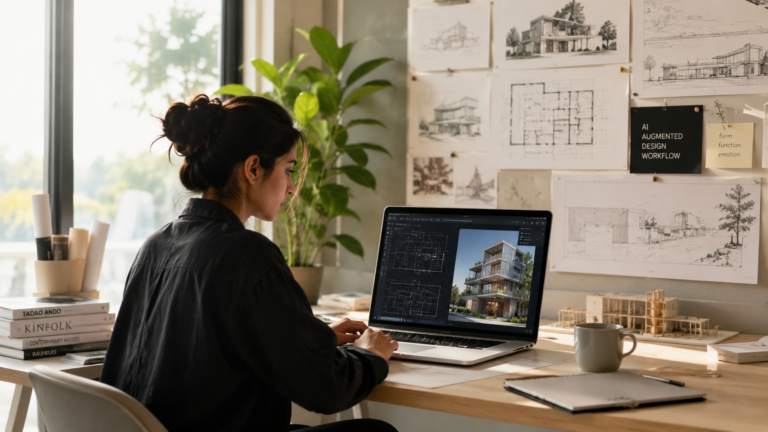
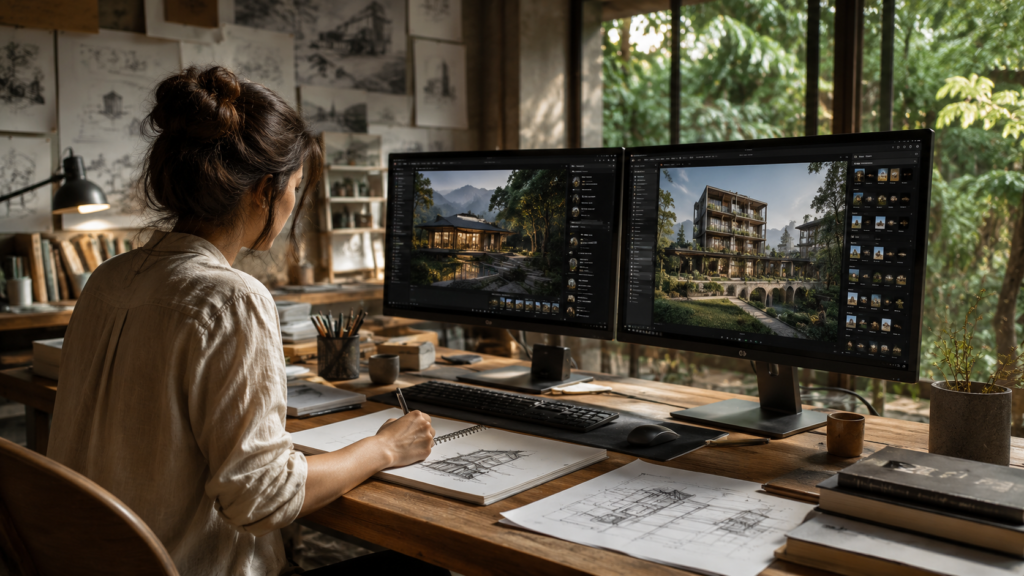
| 🎨 AI IMAGE PROMPT — Before FAQ An architect at a minimal timber desk in a naturally lit studio workspace, dual monitors showing Midjourney AI render outputs of architectural buildings, notebook with hand-drawn sketches, warm morning light, shallow depth of field, cinematic documentary photography style, photorealistic –ar 16:9 –style raw –q 2 Title: Architect Using Midjourney for Architectural Renders ALT: Architect reviewing Midjourney AI architectural renders on dual monitors in a minimal studio workspace with natural light Caption: |
| Q1. How long should a Midjourney prompt for architecture be? A good architectural prompt is typically 50–100 words. Short prompts (under 20 words) produce generic results. Very long prompts (over 150 words) can confuse the model. Aim for specific and concise — cover all 8 formula components without repeating yourself. |
| Q2. Which Midjourney version is best for architectural visualization? Midjourney v6 with –style raw is currently the best option for photorealistic architectural renders. It handles material textures, lighting depth, and spatial perspective better than previous versions. Always include –style raw for architecture work unless you specifically want an illustrated or painterly result. |
| Q3. Can I use Midjourney for client presentations professionally? Yes, but always label Midjourney renders as AI-generated concept visualizations. They are powerful for early-stage concept communication and client mood-boarding. Do not present them as technical or construction-grade drawings. Use them to establish design direction before moving to proper rendering software. |
| Q4. How do I make my Midjourney renders look more Indian or South Asian? Add region-specific materials, vegetation, and climate cues. Use terms like: laterite stone, Mangalore tile, lime plaster, teak timber, terracotta jali, Kota stone, courtyard layout, monsoon light, banana tree, Kerala backwaters, or hot-humid climate. These modifiers ground the render in a specific cultural and climatic context. |
| Q5. What aspect ratio should I use for architectural Midjourney prompts? Use –ar 16:9 for standard presentations and social media. Use –ar 4:3 for square-ish prints and PDF presentations. Use –ar 21:9 for cinematic hero images or wide banners. Use –ar 3:4 for portrait-format social media posts like Instagram stories. |
Key Takeaways
| ✓ The 8-part Midjourney formula — Subject, Style, Setting, Lighting, Camera, Material, Mood, Parameters — is the foundation of every great architectural render. |
| ✓ Midjourney reads prompts left to right. Put the most important information first: subject, then style, then setting. |
| ✓ The –style raw parameter is essential for photorealistic architectural photography outputs in Midjourney v6. |
| ✓ Regional material vocabulary makes renders feel authentic. Generic prompts produce generic renders. Specific materials ground your visuals in climate and culture. |
| ✓ Iterate in three passes. Change one or two variables at a time. Good prompts are refined, not rewritten from scratch. |
| ✓ Lighting is your most powerful creative lever. The same building at golden hour vs. blue hour vs. monsoon overcast creates completely different emotional experiences. |
Continue Exploring
| 🤖 AI Tools for Architects Explore the full ARCNET guide to AI tools in architecture practice — from Midjourney to BIM integration. | 📐 Architectural Drawing Basics Master the fundamentals of architectural communication: plans, sections, elevations, and presentation techniques. |
| 🌏 Tropical Architecture Design Guide Deep dive into climate-responsive design for hot-humid climates — from passive ventilation to shading strategies. | 📸 Architectural Photography Principles Learn the real-world camera and lighting principles that directly translate into better Midjourney prompts. |
Download the Midjourney Prompt Workbook
Get the full prompt library, style matrix, camera guide, and 50 ready-to-use architectural prompts as a printable PDF workbook.