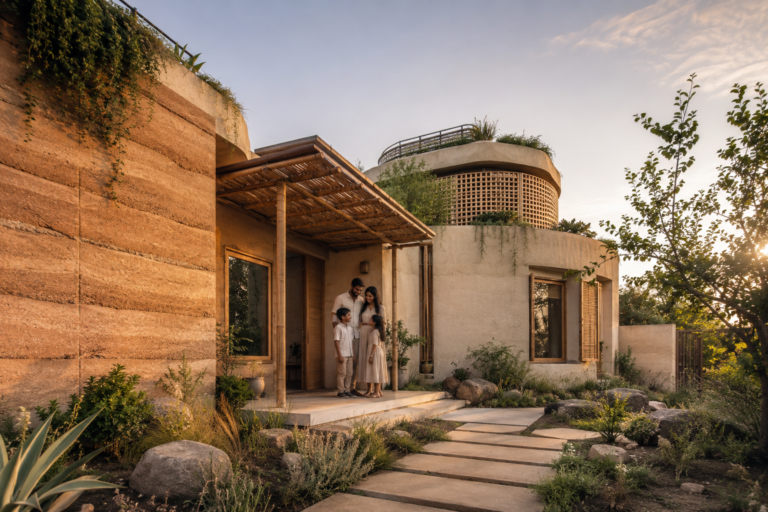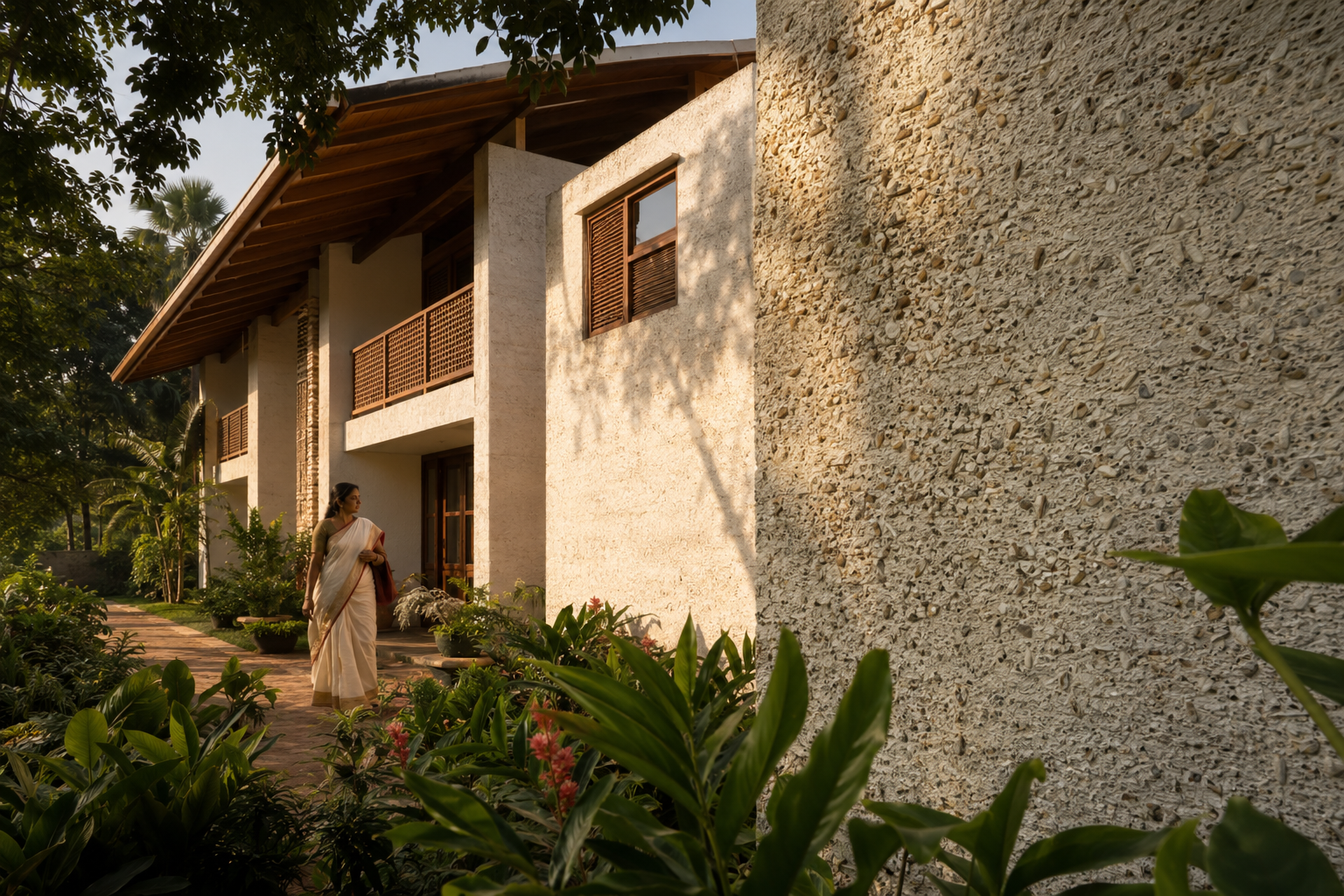
Hempcrete Explained: Benefits, Limitations and Future Potential
Hempcrete Explained: Is It the Future of Sustainable Construction?
Why This Matters
Buildings are responsible for nearly 40% of global carbon emissions. The materials we choose to build with carry a hidden carbon cost — often called embodied carbon — that most homeowners never see on any invoice.
Hempcrete is one of a rare category of materials that actually removes carbon from the atmosphere. The hemp plant absorbs CO₂ as it grows. When mixed into a building material, that carbon is locked in the wall for the life of the building and beyond.
This article exists because the gap between what hempcrete can do and what most homeowners know about it is enormous. If you are planning a new home, a renovation, or just beginning to research sustainable materials — this guide gives you the complete picture without the greenwash.
Who Is This Guide For?
🏡
Homeowners Planning a Build
You want a healthy, energy-efficient home but are unsure whether hempcrete is practical, affordable, or available in your region.
🏛
Architects & Designers
You are specifying materials for a low-carbon project and need a structured comparison of hempcrete against conventional alternatives.
🌱
Sustainability Advocates
You already care about carbon and want to understand the science behind hempcrete’s carbon-negative lifecycle claims.
📚
Architecture Students
You are studying building science and need a clear, evidence-based introduction to natural and low-carbon construction materials.
Quick Navigation
| 01 What Is Hempcrete? The science behind the material and how it is made from hemp hurd and lime. | 02 Carbon Performance Why hempcrete qualifies as a carbon-negative building material — with numbers. |
| 03 Climate Applications How hempcrete performs in hot-dry, hot-humid, temperate and cold climates. | 04 Real-World Projects Case studies from India, Europe, Australia and the Middle East. |
| 05 Limitations & Challenges The honest constraints: cost, skills, regulation and structural limits. | 06 Future Outlook Emerging research, policy direction and where hempcrete is heading. |
Section 1: What Is Hempcrete? The Science Behind the Material
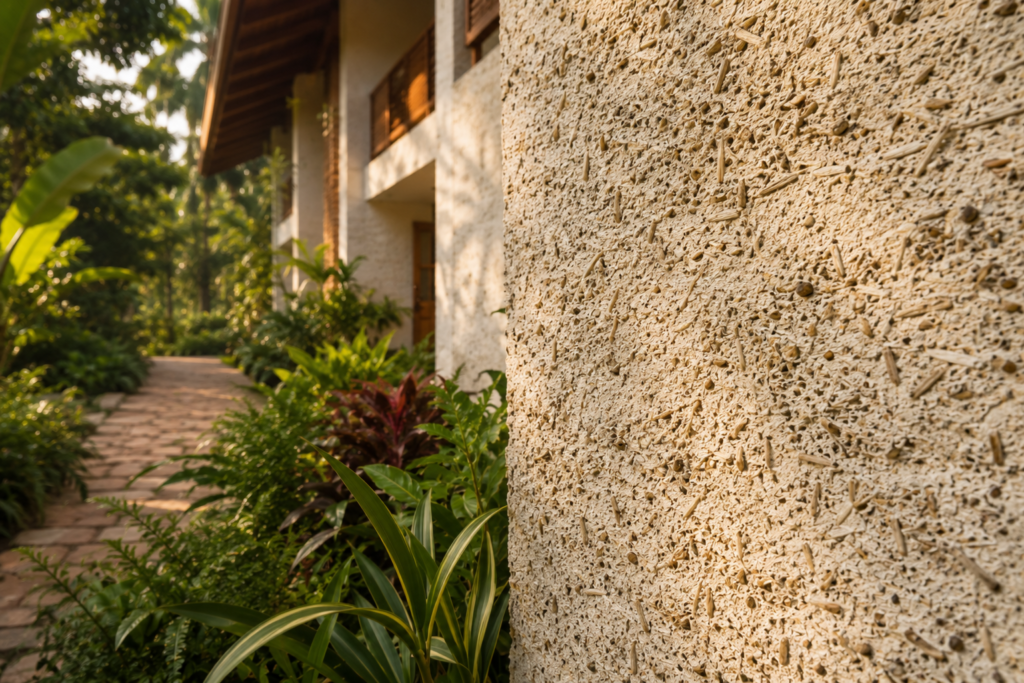
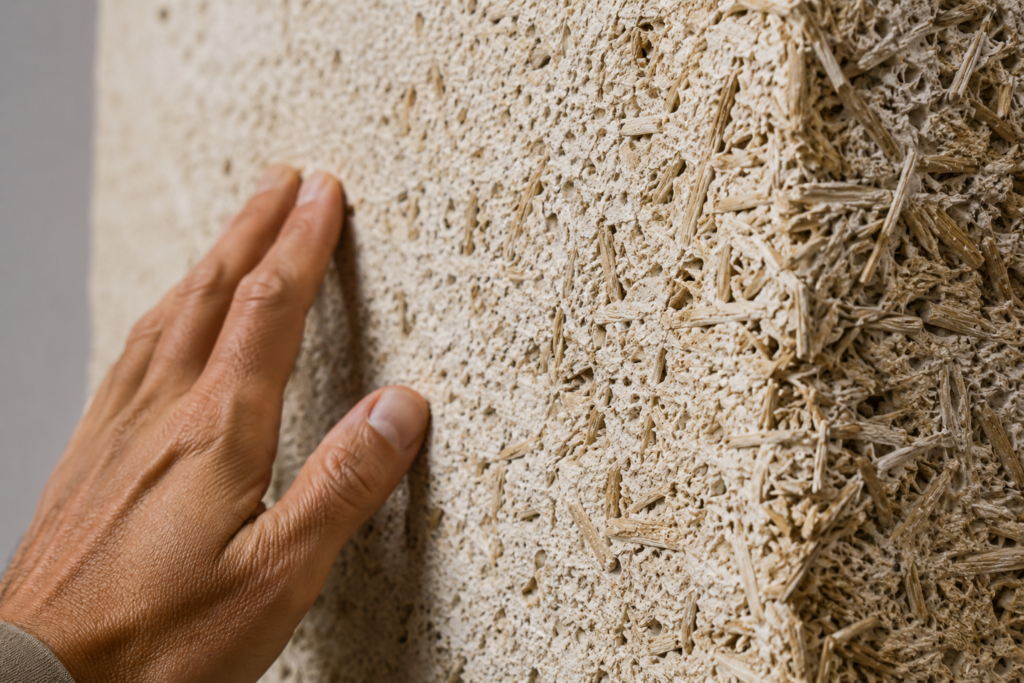
Hempcrete is a bio-composite building material made from three ingredients: hemp hurd (the woody inner core of the Cannabis sativa plant), hydraulic lime binder, and water. These three simple ingredients combine to create a material with remarkable thermal, acoustic, and environmental properties.
The hemp plant grows rapidly — reaching maturity in just 90 to 120 days. During that growth period, each hectare of hemp absorbs approximately 15 tonnes of CO₂ from the atmosphere. When the hemp hurd is mixed with lime and cast into a wall, that carbon is permanently stored in the fabric of the building.
💡 CALLOUT
Hempcrete has been used in building construction in France since the 1980s. France remains the most advanced market for hempcrete research, testing, and commercial adoption — with dedicated building codes (Recommandations Professionnelles) governing its use.
How Hempcrete Is Made
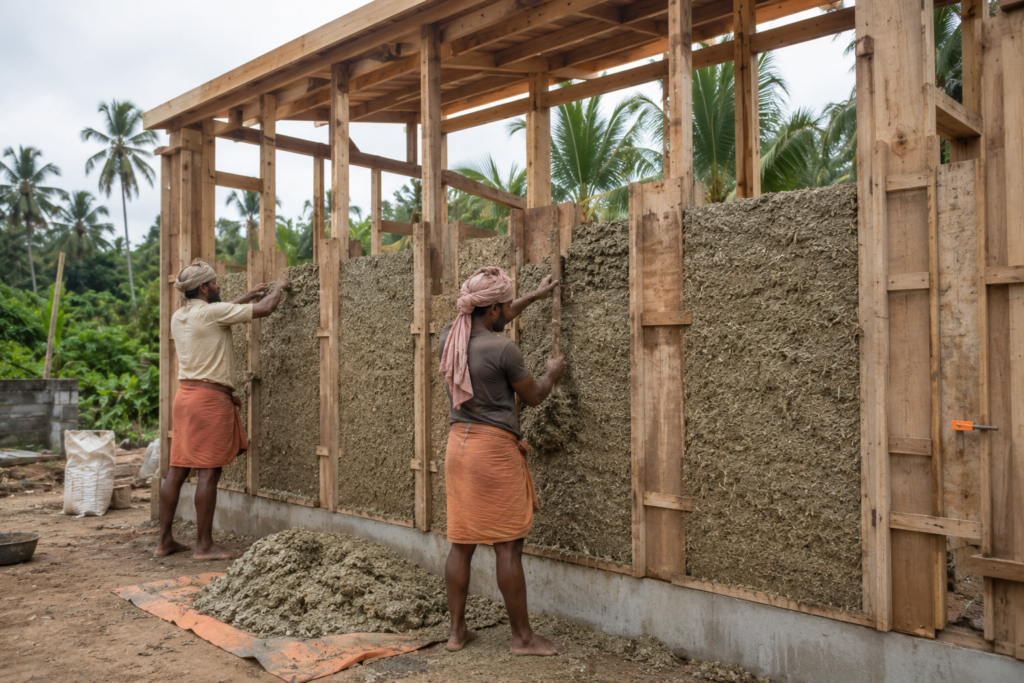
Hemp hurd — also called shiv — is the chopped woody core of the hemp stalk. After harvesting, the fibre is separated and the hurd is dried. It is then combined with a hydraulic lime binder in roughly 3:1 ratio (hurd to lime by volume) and mixed with water to form a wet slurry.
The mixture is cast into formwork around a structural frame — typically timber, steel, or concrete columns. It is not poured; it is tamped or sprayed in layers. The result is a monolithic wall with no joints — a continuous, breathable, thermally efficient mass.
✅ TIP
If you are specifying hempcrete for the first time, start with internal wall panels or a single room. This lets your contractor build experience and allows you to evaluate the material’s performance before committing to a full build.
The Role of Lime in Hempcrete
Lime is the binding agent that holds the hemp hurd together and gives hempcrete its durability. As the lime cures over weeks and months, it petrifies the hemp hurd — locking in the stored carbon and creating a hard, stone-like matrix. Lime also provides hempcrete’s fire resistance and its ability to regulate moisture.
Hempcrete vs. Traditional Concrete
Despite its name, hempcrete is not a structural material in the way concrete is. It cannot carry vertical loads alone. What it does — better than concrete — is insulate, breathe, absorb moisture, store carbon, and create a healthier indoor environment. Think of it less as a replacement for concrete and more as a high-performance infill wall system.
⚠️ WARNING
Do not use hempcrete below ground level or in direct contact with water. It is not suitable for foundations or basement walls. Always include a DPC (damp proof course) and ensure good drainage around any hempcrete structure.
Section 2: Carbon Performance — Why Hempcrete Is Carbon Negative
When we talk about carbon in construction, we are really talking about two things: the carbon emitted during manufacturing (embodied carbon) and the carbon absorbed or released over the building’s lifetime (operational carbon). Hempcrete performs exceptionally on both measures.
💡 CALLOUT
Research by the University of Bath (UK) found that a hempcrete wall stores approximately 35-110 kg CO₂/m³ over its lifetime — making it one of the highest-performing carbon-storing materials available for mainstream construction.
The Carbon Math
A standard concrete block wall produces approximately 150-200 kg of CO₂ per cubic metre during manufacture. A hempcrete wall of the same size sequesters approximately 110 kg of CO₂ — meaning the hemp plant absorbed that carbon from the atmosphere during growth, and it stays locked in the wall permanently.
When you account for the lime production (which does emit some CO₂), the net balance for hempcrete is still negative. Industry studies estimate a net carbon sequestration of 35-80 kg CO₂ per cubic metre, depending on the lime type used and the specific mix.
Carbon Negative vs. Carbon Neutral — What Is the Difference?
Carbon neutral means you offset all emissions — the total net release is zero. Carbon negative means the material actually removes more carbon from the atmosphere than it releases at any point in its lifecycle. Hempcrete is in the rare second category, alongside timber construction and some forms of earthen building.
✅ TIP
When comparing carbon footprints with your architect, ask for a Life Cycle Assessment (LCA) for both hempcrete and your alternative material. Numbers vary by region, lime supplier, and transport distance. A local LCA gives you the most accurate comparison for your specific project.
The Carbon Scorecard
| Category | Hempcrete | Concrete | Score |
| CO₂ Sequestered | ~110 kg/m³ | 0 | Hempcrete ✅ |
| Embodied Carbon | Very Low | High | Hempcrete ✅ |
| Carbon over 50 years | Negative | Positive | Hempcrete ✅ |
| Production Energy | Low | Very High | Hempcrete ✅ |
| End-of-life Impact | Compostable | Landfill | Hempcrete ✅ |
Lifecycle Carbon — The Long View
Hempcrete walls in well-maintained buildings can last 100 years or more. Unlike concrete, which slowly releases CO₂ as it degrades, hempcrete locks in its stored carbon for the entire life of the building. At end of life, hempcrete can be crushed and returned to agricultural soil — completing a carbon cycle that began in a hemp field.
⚠️ WARNING
Not all hempcrete products are equal on carbon. Pre-mixed hempcrete blocks require kilning and transport that add embodied carbon. Cast-in-place hempcrete using locally sourced hemp hurd will almost always have a lower carbon footprint than imported blocks. Ask your supplier for product-specific carbon data.
Section 3: Climate Applications — How Hempcrete Performs Around the World
One of the most impressive qualities of hempcrete is its climate adaptability. The same material that keeps a French farmhouse warm in winter works just as effectively to cool a home in Kerala or moderate humidity in Singapore. This versatility comes from its unique combination of thermal mass and breathability.
💡 CALLOUT
Hempcrete’s vapour permeability is one of its most important and often underestimated properties. In any climate where moisture movement through walls matters — which is most climates — hempcrete outperforms plastic-membrane-based insulation systems because it manages moisture without trapping it.
Hot-Humid Climates — India, Southeast Asia, Bangladesh
In hot-humid climates, moisture management is the critical challenge. Conventional concrete walls trap moisture, leading to mould growth, structural decay, and poor indoor air quality. Hempcrete walls breathe — they absorb excess humidity during the day and release it at night, maintaining a comfortable indoor humidity level of 50-60% without mechanical dehumidification.
In cities like Chennai, Mumbai, Colombo, and Dhaka, hempcrete’s ability to buffer both heat and humidity can significantly reduce the load on air conditioning systems. A well-designed hempcrete home in a hot-humid climate can reduce cooling energy use by 20-40% compared to a conventional concrete home.
✅ TIP
For hot-humid climates specifically, specify hempcrete with an unpainted, breathable lime plaster finish. Sealing the surface with paint or cement render negates hempcrete’s moisture-buffering capacity — which is one of its primary climate benefits.
Hot-Dry Climates — Rajasthan, Middle East, North Africa
In hot-dry climates, thermal mass is the most valuable property a wall material can have. Hempcrete’s density allows it to absorb heat during the day and release it slowly at night — flattening the temperature curve inside the home. This mirrors the ancient logic of rammed earth and mud brick construction that has served communities in the Middle East and Rajasthan for thousands of years.
Projects in Dubai, Abu Dhabi, and the arid regions of Morocco have demonstrated hempcrete’s effectiveness as an insulating infill wall within steel or concrete structural frames — reducing peak cooling loads by 25-35%.
Temperate Climates — Europe, Australia, New Zealand
Europe is the most mature hempcrete market in the world. France, the UK, Germany, and the Netherlands have certified hempcrete products, trained contractors, and detailed building codes. In the UK, the Hemp Lime Construction Products Association (HLCPA) has established technical guidance widely used by architects and engineers.
Australia is a growing market, with projects in New South Wales and Queensland demonstrating hempcrete’s performance in both humid subtropical and temperate zones. Hemp Australia is one of the largest domestic suppliers, enabling genuinely local, low-transport-carbon hempcrete construction.
Cold Climates — Canada, Northern Europe, High-Altitude India
In cold climates, insulation value (R-value / U-value) is paramount. Hempcrete alone provides modest insulation — approximately R-2.5 per inch, less than polyurethane foam insulation. The solution in cold climates is to use hempcrete in combination with additional insulation layers, or to increase wall thickness significantly.
In Canada and Scandinavia, timber-frame hempcrete homes with 400-500mm wall thickness achieve excellent thermal performance while maintaining the material’s carbon, health, and acoustic benefits. Several Passivhaus-certified buildings in Germany have incorporated hempcrete as part of their fabric strategy.
⚠️ WARNING
In very cold climates (below -15°C sustained), hempcrete alone is insufficient as the sole insulation strategy. Always consult a building physicist or energy consultant for projects where external temperatures regularly drop below freezing for extended periods.
Section 4: Real-World Projects — Hempcrete in Action
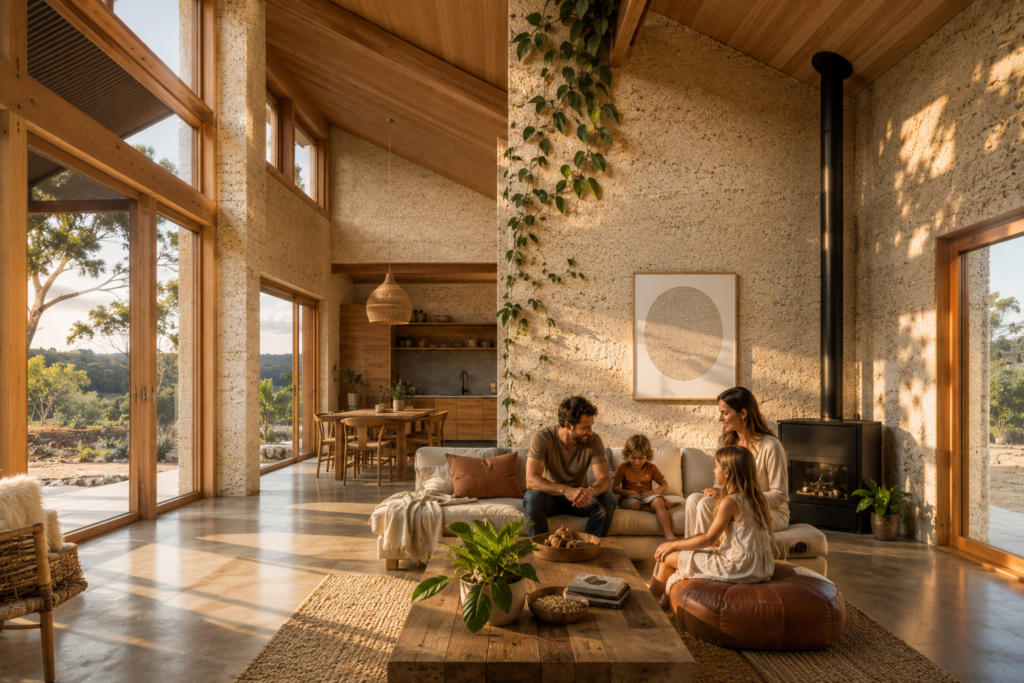
Hempcrete is no longer a fringe material used only by experimental builders. Across multiple continents, architects, developers, and homeowners are demonstrating that it is a practical, buildable, and cost-competitive choice for sustainable construction.
💡 CALLOUT
The Hempcrete Company (UK) and IsoHemp (Belgium) are the two most established commercial hempcrete product manufacturers in Europe. Both produce pre-formed hempcrete blocks that can be specified by architects in the same way as AAC blocks, with standard fire, thermal, and structural data sheets available.
France — The Home of Hempcrete
France has the world’s most developed hempcrete industry. The Maison en Chanvre movement in rural France has produced thousands of hempcrete homes since the late 1980s. The Recommandations Professionnelles Chanvre et Chaux (Professional Recommendations for Hemp and Lime) provide detailed guidance on mix ratios, wall thicknesses, and structural framing — a model that other countries are now adapting.
One notable example: a 220m² family home in Normandy used a timber post-and-beam frame with hempcrete infill walls. The owners report consistent internal temperatures of 19-21°C year-round, with no mechanical heating or cooling beyond a small wood stove.
United Kingdom — Commercial Scale
The UK has scaled hempcrete beyond individual homes. The most significant example is the Marks & Spencer Cheshire Oaks store — one of the first large commercial buildings in the world to use hempcrete as an insulating wall system. The project demonstrated that hempcrete can work at scale, can be delivered on commercial timelines, and can meet the performance requirements of a major retail environment.
Residential hempcrete projects across Wales and Scotland have won multiple sustainable building awards, demonstrating that hempcrete can meet not just environmental targets but also aesthetic and planning requirements in both rural and urban contexts.
✅ TIP
Before specifying hempcrete for a project in India or Southeast Asia, contact the Natural Building Collective or reach out to architecture schools in Bengaluru and Ahmedabad that are actively researching bio-based construction. They can connect you with the nearest contractors and suppliers.
India — Emerging Applications
India’s hempcrete story is still early, but it is accelerating. Uttarakhand and Himachal Pradesh — both states where industrial hemp cultivation is legal — have seen a small number of pioneering builds. The combination of local hemp sourcing, traditional lime knowledge, and the climate challenges of both high-altitude cold zones and humid foothills makes India a compelling market.
Architects in Kerala and Tamil Nadu have begun specifying hempcrete for coastal homes where conventional masonry struggles with humidity and salt air exposure. The material’s resistance to moisture damage makes it particularly well-suited to the Indian coastal environment.
Australia and North America — Regulation and Growth
In Australia, hempcrete has been used in residential projects since the early 2010s. As of 2024, it can be specified under the National Construction Code with appropriate engineering documentation. Queensland and New South Wales have seen the most activity.
In the United States, the 2018 Farm Bill removed hemp from the controlled substances list, opening the door for commercial hemp cultivation and domestic hempcrete production. Projects in Vermont, California, and Texas are among the most documented — with Vermont in particular emerging as a hub for natural building education and research.
⚠️ WARNING
Be cautious of suppliers who cannot provide mix ratio data, cure time data, or any form of third-party testing. Hempcrete’s performance is highly dependent on the specific mix and the skill of the applicator. Always ask for a sample panel before committing to a full build.
Section 5: Limitations and Challenges — The Honest Reckoning
Hempcrete is an exceptional material. But it is not perfect, and it is not for every project. Understanding its real limitations is just as important as understanding its benefits. This section is where we put aside the enthusiasm and look at the hard constraints.
💡 CALLOUT
The cost premium of hempcrete almost always shrinks over a 10-20 year horizon when energy savings are included in the calculation. A hempcrete home that reduces annual cooling and heating costs by 25-40% can recover the initial premium within 8-15 years, depending on energy prices and climate.
It Cannot Stand Alone Structurally
This is the most fundamental limitation of hempcrete. Unlike concrete, brick, or even AAC block, hempcrete cannot carry vertical structural loads. It must be used as an infill material within a separate structural frame — timber, steel, or concrete columns and beams carry the building’s load, and the hempcrete fills the space between.
This is not a dealbreaker, but it does add design complexity and cost. For a standard single-family home, the structural frame represents an additional cost of 10-20% compared to a load-bearing masonry build. For large commercial projects, the frame is typically already part of the design — so hempcrete fits naturally as the infill wall choice.
Cost and Supply Chain Gaps
Hempcrete typically costs 15-35% more than conventional masonry for the same wall area, when you include material, formwork, and skilled labour. This premium comes from several sources: the relative scarcity of hemp hurd supply chains outside major markets, the need for skilled labour, longer site time for casting and curing, and the small batch nature of most hempcrete production.
✅ TIP
For projects in markets without established hempcrete supply chains, consider specifying cast-in-place hempcrete using locally sourced materials. Partner with a university or research institution to validate the mix — this approach also builds local knowledge that benefits future projects.
In India, Southeast Asia, and most of the Middle East, the supply chain for hemp hurd is essentially absent. Lime is universally available, but obtaining hemp shiv at scale requires either importing from Europe or establishing a local processing network. This is the single biggest barrier to hempcrete adoption in developing markets.
Regulatory and Skills Gaps
In most countries outside France, the UK, and Australia, hempcrete sits in a grey zone in building codes. It is not explicitly prohibited, but it is also not explicitly approved — which means each project may require additional engineering documentation, local authority consultation, or performance testing to obtain building permits.
Equally important is the skills gap. Hempcrete requires different handling, mixing, and casting techniques from conventional masonry. In markets where hempcrete is rare, finding experienced contractors is the number one practical challenge for any project team.
Performance Caveats
Hempcrete is not waterproof. It must be protected from prolonged direct rain exposure during construction — formwork or temporary cover is essential. The lime binder takes 2-6 weeks to begin curing and can take 6-12 months to reach full strength, depending on climate. Projects need to account for this curing time in their construction schedules.
⚠️ WARNING
Hempcrete must be protected from rain during the first 4-8 weeks of curing. Uncured hempcrete exposed to sustained wetting can lose cohesion and fail to bond properly. Always include a weather protection strategy in your construction sequence when using hempcrete.
Section 6: The Future of Hempcrete — Research, Policy and Potential
Hempcrete is at an inflection point. The combination of climate urgency, rising interest in healthy buildings, and expanding industrial hemp cultivation is creating the conditions for a step-change in adoption. This section looks at where hempcrete is going — and what needs to happen for it to reach mainstream construction.
💡 CALLOUT
The International Hemp Building Association (IHBA) is the global body advancing hempcrete research, standards, and policy. Their published guidelines are freely available online and represent the most current technical consensus on hempcrete specification worldwide.
Advances in Mix and Performance
Research teams at Loughborough University (UK), Rennes University (France), and CSIRO (Australia) are actively working on enhanced hempcrete formulations. Key areas include: faster-curing lime binders, spray-applied hempcrete for faster construction, hybrid hempcrete-mycelium composites for even greater carbon storage, and pre-cast hempcrete panels engineered for structural performance.
Spray hempcrete — which can be applied using modified plaster machines — is reducing labour costs and speeding up construction time significantly. Several commercial projects in France and the UK are already using this method at scale.
✅ TIP
If you are an architect or builder wanting to get ahead of the hempcrete curve, consider pursuing training through the HLCPA (UK) or the Builders Without Borders programme. Both offer short courses in natural building including hempcrete that can position you as an early specialist in a growing market.
Policy and Building Code Progress
In 2023, the US National Building Code made it easier for states to adopt performance-based approvals for bio-based materials including hempcrete, removing the need for custom engineering documentation in many standard residential builds. The EU’s Green Deal and Taxonomy Regulation are also creating financial incentives for carbon-storing materials — which hempcrete clearly qualifies for.
In India, the Bureau of Indian Standards (BIS) does not yet have a specific standard for hempcrete, but the 2023 amendment to hemp cultivation laws across more Indian states is creating the agricultural base that a domestic hempcrete industry will need. Policy advocacy by natural building groups is now pushing for a formal IS code.
Scaling the Supply Chain
The most important structural change needed for hempcrete to go mainstream is the development of regional hemp hurd processing infrastructure. Hemp is already being grown for CBD oil in many markets — the hurd is currently a waste byproduct of that process in many cases. Building a collection and processing network for hemp shiv from CBD operations represents a near-zero cost addition to an already existing agricultural system.
Hempcrete and the Net-Zero Agenda
As net-zero building targets become regulatory requirements in more countries — the UK mandates net-zero new homes from 2025, the EU from 2028, and India has ambitious 2070 targets — materials that actively store carbon will move from niche to necessary. Hempcrete’s carbon negative profile makes it one of the few building materials that can actively help meet a net-zero target, not just reduce the damage.
⚠️ WARNING
Be aware that ‘hemp-based’ products are a wide category. Hemp wood, hemp fibre insulation, hemp boards and hempcrete are all different materials with different properties, performance data, and regulatory status. Always verify exactly which hemp product is being specified and ensure you have the correct technical data sheet.
Material Comparison Matrix
Use this matrix to compare hempcrete against the most common alternative wall systems across the key performance criteria.
| Material | Thermal Mass | Carbon Impact | Breathability | Cost | Availability |
| Hempcrete | High | Carbon negative | Excellent | Medium-High | Limited |
| Concrete | High | High emitter | Poor | Low | Universal |
| AAC Block | Medium | Moderate | Good | Medium | Wide |
| Mud/Adobe | High | Carbon neutral | Excellent | Low | Regional |
| Timber Frame | Low | Carbon negative | Good | Medium | Wide |
| Brick | High | Moderate | Moderate | Low-Medium | Universal |
Hempcrete — Pros and Cons Chart
A balanced view of what hempcrete does well and where it has real limitations.
| ✅ PROS | ⚠️ CONS |
| ✅ Carbon negative lifecycle | ⚠️ Cannot be load-bearing alone |
| ✅ Excellent thermal insulation | ⚠️ Limited skilled contractors |
| ✅ Natural moisture regulation | ⚠️ Higher upfront cost |
| ✅ Fire resistant (lime binder) | ⚠️ Long curing time (weeks–months) |
| ✅ Non-toxic, healthy indoor air | ⚠️ Regulatory gaps in many regions |
| ✅ Pest and mould resistant | ⚠️ Hemp availability varies by country |
| ✅ Acoustic performance | ⚠️ Requires lime binder (some CO₂) |
| ✅ Renewable crop source | ⚠️ Not suitable for below-grade use |
Material Selection Guide
Not sure which material is right for your project? Use this guide to match your priority to the best material choice.
| Your Priority | Best Material Choice | Why? |
| Lowest carbon footprint | Hempcrete or Timber | Both sequester carbon during growth |
| Best thermal comfort | Hempcrete or Mud Block | High thermal mass + breathability |
| Lowest cost | Concrete or Brick | Widely available, cheap to produce |
| Fastest construction | AAC Block or Timber | Light weight, quick to assemble |
| Healthiest indoor air | Hempcrete or Mud Block | Natural, breathable, no off-gassing |
| Fire safety | Hempcrete or Brick | Lime/clay binders resist ignition |
| Hot-humid climate | Hempcrete or Timber | Moisture buffering and ventilation |
| Cold climate | Hempcrete + Timber | High insulation + thermal mass |
Key Takeaways
| ✓ Hempcrete is a carbon-negative material — it absorbs more CO₂ over its lifetime than it produces during manufacture. |
| ✓ It cannot carry structural loads alone and must be used within a separate structural frame. |
| ✓ Hempcrete performs well in all major climate zones — from hot-humid India to cold-climate Canada — with appropriate design adaptations. |
| ✓ Cost is 15-35% higher than conventional masonry, but energy savings recover the premium over 8-15 years. |
| ✓ Regulatory approval and skilled contractors are the two biggest practical barriers to adoption in most markets. |
| ✓ France and the UK are the most advanced markets; India, Southeast Asia, and the Middle East are emerging markets with strong potential. |
| ✓ The future of hempcrete depends on scaling the hemp hurd supply chain and establishing regional building codes. |
Frequently Asked Questions — Hempcrete
Q: Is hempcrete legal to use in India?
A: Industrial hemp cultivation is legal in several Indian states including Uttarakhand, Himachal Pradesh, and Manipur. Using hempcrete as a construction material is not prohibited, but there is currently no specific IS code governing its use. Projects require engineering documentation and local authority approval. This situation is expected to change as the domestic hemp industry matures.
Q: How long does hempcrete last?
A: Well-built hempcrete structures can last 100 years or more. The lime binder continues to slowly petrify the hemp hurd over decades, actually becoming harder with time. The primary risk to longevity is sustained moisture exposure — a well-designed hempcrete structure with good roof overhangs and drainage will outlast most conventional masonry.
Q: Can I use hempcrete for a multi-storey building?
A: Hempcrete can be used in multi-storey buildings, but the structural frame must carry all loads. The hempcrete acts as an infill wall at every level. There are completed two- and three-storey hempcrete homes in Europe and the UK. Taller buildings require more detailed engineering input to ensure the frame handles the cumulative loads correctly.
Q: Is hempcrete available in India or Southeast Asia?
A: Currently, hempcrete is not widely commercially available in most of India or Southeast Asia. Hemp hurd must typically be imported from Europe or Canada, which adds cost and embodied carbon. A small number of specialist natural builders in Bengaluru, Pune, and Kerala are experimenting with locally sourced hemp hurd from Uttarakhand. This is a fast-evolving situation — check with natural building networks for the most current information.
Q: How does hempcrete compare to mud brick or rammed earth?
A: Mud brick and rammed earth also have low embodied carbon and excellent thermal mass, and both are far more widely available in India and South Asia than hempcrete. Hempcrete has the edge on moisture buffering, insulation value, and carbon sequestration. Rammed earth and mud brick have the edge on structural performance, local availability, and cost. The best choice depends on your specific site, climate, and budget.
30-Day Action Plan — Your Path to a Hempcrete Decision
You do not need to commit to hempcrete today. But if you are serious about exploring it, this 30-day roadmap will get you to a confident, informed decision.
Week 1 — Research
- Read 2-3 hempcrete case studies from your climate region.
- Search for hemp hurd (shiv) suppliers in your country.
- Download this guide and share with your architect.
Week 2 — Feasibility
- Check local building codes for natural material approvals.
- Get a quote from a hempcrete contractor or natural builder.
- Compare hempcrete cost vs AAC block for your project size.
Week 3 — Planning
- Decide wall type: hempcrete infill or full hempcrete system.
- Select lime binder supplier (hydraulic or natural lime).
- Plan the structural frame (timber, steel, or concrete column).
Week 4 — Decision
- Review carbon savings versus cost premium with your team.
- Confirm contractor experience — ask for past project photos.
- Make your final material decision and update your brief.
Quick Wins Checklist — Hempcrete at a Glance
Before you read the full article, here are the fast facts you need to know about hempcrete.
☐ Hempcrete is made from hemp hurd (the woody core of the hemp plant) mixed with lime and water.
☐ It is carbon negative — it absorbs more CO₂ than it produces over its lifetime.
☐ It cannot be used as a structural load-bearing wall on its own — it needs a frame.
☐ Hempcrete naturally regulates moisture and temperature, reducing energy bills.
☐ It is pest-resistant, mould-resistant and non-toxic — ideal for healthy homes.
☐ It is not yet widely available everywhere — check local supplier access first.
☐ Cost is 10-30% higher than conventional materials, but energy savings offset this over time.
☐ It is approved for construction use in France, UK, USA, Australia and growing list of countries.
Continue Exploring — ARCNET Sustainable Materials Series
| 📄 12 Sustainable Material Changing Home Design in 2026 A head-to-head deep dive into two of the most sustainable wall systems for tropical and arid climates. | 📄 Coming Soon – Lime Plaster Guide: The Perfect Partner for Natural Walls How to choose and apply the right lime finish for hempcrete, mud, and stone walls. |
| 📄 Coming Soon – Carbon in Construction: A Homeowner’s Guide to Embodied Carbon Understand embodied carbon in simple terms and how your material choices affect your home’s carbon footprint. | 📄 Coming Soon – Bamboo in Construction: Structure, Cladding and Finishes Everything you need to know about specifying structural and decorative bamboo for tropical climate builds. |
Ready to Build Smarter?
Download the ARCNET.STUDIO Sustainable Materials Quick Guide — a free PDF
Covering hempcrete, mud brick, bamboo, reclaimed timber, and more. Compare materials, understand carbon, and make informed decisions for your next project. → Download Free PDF