Water-Wise Garden Trends and Xeriscaping Techniques for Modern Homes
Why This Matters
Fresh water is the world’s most stressed resource. By 2030, global demand for water is expected to outpace supply by 40%. In countries like India, parts of Southeast Asia, and the Middle East, entire cities already face seasonal drought or acute water shortages.
Yet the average homeowner’s garden can consume more water than the entire household combined. Sprinkler systems, thirsty lawns, and poorly timed irrigation quietly drain thousands of litres every week — with little to show for it when summer arrives and plants still struggle.
Water-wise garden design changes that equation. By choosing the right plants, improving your soil, and managing irrigation smartly, you can grow a garden that looks beautiful in any season while using a fraction of the water. This isn’t about sacrificing beauty. It’s about designing smarter from the start.
Who Is This Guide For?
🏠
First-Time Homeowners
Setting up a new garden? This guide helps you avoid costly irrigation mistakes and design a garden that thrives from Day 1 without excessive water bills.
🌡️
Homeowners in Hot or Dry Climates
If you live in Rajasthan, Dubai, or Queensland, xeriscaping principles can transform a bare, sun-scorched yard into a resilient, colourful landscape.
🔁
Renovating an Existing Garden
Ready to replace your thirsty lawn? This guide gives you a practical step-by-step framework to transition to a low-water landscape without starting from scratch
🌿
Sustainability-Focused Homeowners
If reducing your environmental footprint matters to you, water-wise design is one of the highest-impact changes you can make to your home’s resource use.
Quick Navigation
| 1️⃣ Understanding Water-Wise Principles Section 1 — Learn the six core principles that underpin every successful water-wise garden. | 2️⃣ Xeriscaping Techniques Section 2 — Practical xeriscaping methods to slash water use without sacrificing beauty. |
| 3️⃣ Plant Selection by Climate Section 3 — Choose the right plants using the ARCNET Plant Selection Matrix. | 4️⃣ Soil and Mulch Section 4 — How soil prep and mulching form the invisible foundation of a water-wise garden. |
| 5️⃣ Irrigation Systems Guide Section 5 — Compare drip, soaker hose, and smart irrigation systems for your garden size. | 6️⃣ Design and Planning Section 6 — Use the Garden Planning Worksheet to design your water-wise space with confidence. |
Section 1 — Understanding Water-Wise Garden Design Principles
1. Understanding Water-Wise Garden Design Principles
Water-wise garden design is built on a simple idea: give your garden exactly what it needs and nothing more. It is not about having a bare or boring landscape. It is about understanding how water, plants, and soil interact — and then designing your garden to work with those systems instead of against them.
1.1 The Six Core Principles
Six principles form the backbone of every water-wise garden, from small urban courtyards in Chennai to sprawling suburban blocks in Melbourne.
- Planning and design: map sun, shade, and wind before planting
- Soil improvement: build soil that holds moisture where roots can use it
- Plant selection: choose plants suited to your climate and rainfall
- Practical lawn areas: reduce or eliminate thirsty turf where it serves no purpose
- Efficient irrigation: use drip or subsurface systems rather than overhead sprinklers
- Mulching: cover bare soil to prevent evaporation and suppress weeds
💡 What Is Xeriscaping?
Xeriscaping (from the Greek word ‘xeros’, meaning dry) is a landscaping philosophy developed in the 1980s in Denver, Colorado, USA in response to chronic drought. It applies equally well to water-stressed regions across India, the Middle East, and Southeast Asia. The goal is not a desert-like garden — it is a beautiful, layered landscape that uses dramatically less water than a conventional garden.
1.2 Planning Before You Plant
The most expensive water-wise mistake is buying plants before understanding your garden’s conditions. Spend one week observing where the sun falls, where rain pools, and where wind dries the soil fastest. Sketch a simple map noting wet zones, dry zones, shaded areas, and spots with reflected heat from walls or paving.
In cities like Mumbai or Bangkok, shaded north-facing walls stay moist and cool. South- or west-facing beds near masonry walls in Riyadh or Dubai become radiant heat traps that desiccate ordinary plants within days. Understanding these microclimates before you plant is the single most impactful step in water-wise design.
✅ TIP
Water at dawn, not midday. Dawn watering reduces evaporation loss by up to 30% compared to afternoon irrigation. It also reduces fungal disease by ensuring leaves dry before nightfall.
1.3 Understanding Your Rainfall Pattern
Water-wise design works differently in hot-dry climates (Rajasthan, Dubai, Arizona) than in hot-humid regions (Kerala, Singapore, Queensland). In humid climates, the goal is drainage and air circulation — avoiding waterlogged roots that rot despite frequent rain. In dry climates, the challenge is moisture retention and shade management.
Know your average annual rainfall, your dry season length, and your soil’s natural drainage before committing to any design. Free tools like Open-Meteo and your municipality’s water authority website often provide historical rainfall data.
1.4 Zoning for Water Use
Divide your garden into three irrigation zones: high water (kitchen herb garden, children’s play area planting), medium water (feature planting beds), and low or no supplemental water (native gravel gardens, ornamental grass lawns). Place high-water zones closest to the house, where you’ll notice dryness quickly. Transition to low-water zones as you move toward boundaries and streetscapes.
⚠️ WARNING
Never plant a high-water species in full sun without mulch and drip irrigation. In hot climates, an unprotected thirsty plant can draw three times the water it would need if properly mulched and shaded. Always plan irrigation before you plant.
2. Xeriscaping Techniques That Work in Any Climate
Xeriscaping is not a single technique — it is a collection of practical strategies that work together. Each one reduces water demand independently. Used together, they can cut landscape water use by 50–75%.
2.1 Replacing Lawn with Low-Water Alternatives
Conventional turf grass is the single thirstiest element in most residential gardens. A 100 sq m lawn can use up to 400 litres of water per day in summer. Replacing it — even partially — with gravel, low-growing native groundcovers, or permeable paving has an immediate impact.
In India, options like Doob grass (Cynodon dactylon) or Zoysia japonica offer far lower water demand than imported cultivars. In Australia, buffalo grass hybrids like Sir Walter require 40% less water than standard couch. In the UK, no-mow meadows with wildflowers and clover outperform rye grass lawns on every sustainability metric.
💡 Permeable Paving
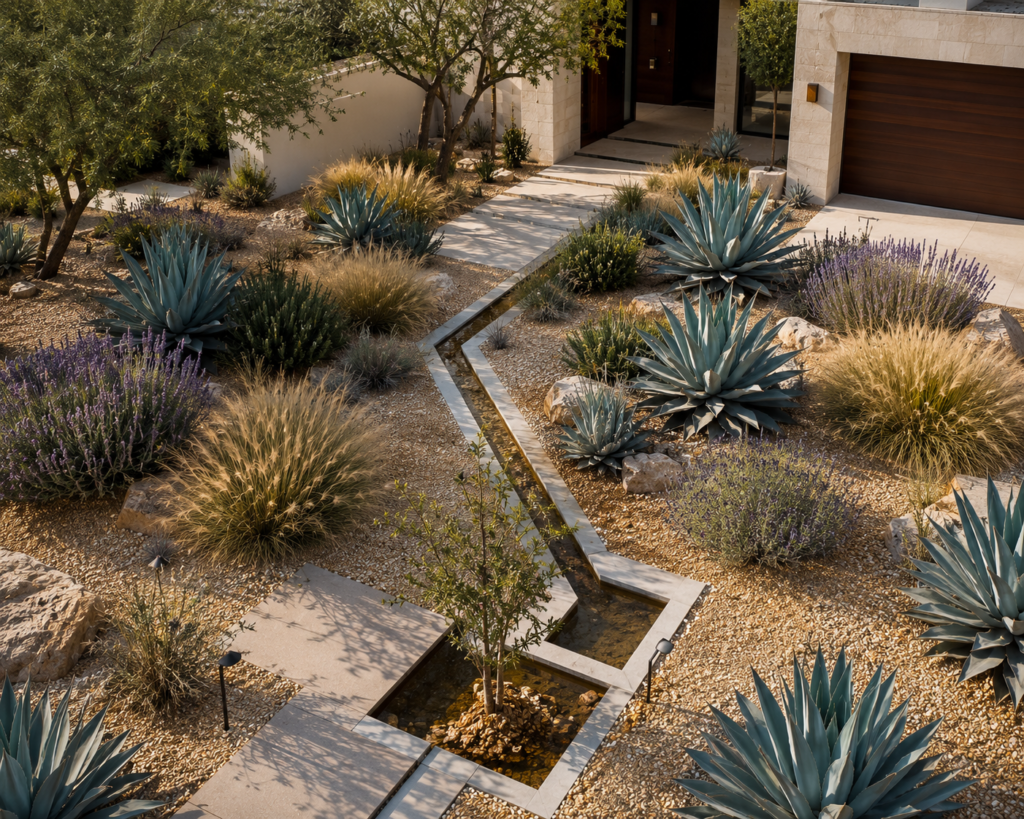
Replacing impermeable concrete with gravel, crushed rock, or permeable pavers allows rainfall to percolate into the soil rather than running off. This recharges groundwater, reduces flooding, and feeds deep plant roots. In cities like Bengaluru, where rapid urbanisation has reduced natural groundwater recharge, permeable paving in private gardens can make a meaningful contribution to neighbourhood water tables.
2.2 Rainwater Harvesting
Even in dry climates, significant rainfall occurs in concentrated bursts. Capturing that water for use during dry periods is one of the most cost-effective water-wise strategies available.
A simple 1,000-litre tank connected to a roof downpipe can supply a significant portion of a small garden’s seasonal needs. In states like Karnataka, Maharashtra, and Tamil Nadu, rooftop rainwater harvesting is mandatory for new buildings above a certain size — but optional retrofits are widely available and straightforward to install.
✅ TIP
A 100 sq m roof area in a region receiving 600mm of annual rainfall can capture approximately 54,000 litres per year — enough to irrigate a modest water-wise garden through dry months with careful management.
2.3 Sheet Mulching to Remove Lawn
Sheet mulching (also called lasagne mulching) is one of the easiest ways to kill lawn without digging. Mow the existing lawn short. Lay cardboard directly over it, overlapping edges by 15cm. Wet the cardboard thoroughly. Layer 150mm of composted mulch on top. The cardboard smothers the grass, which decomposes over 3–6 months. Plant directly into the mulch layer immediately.
This technique works well in the UK, Australia, North America, and wetter parts of India. In arid climates, ensure you provide irrigation support during the transition period.
2.4 Creating Swales and Rain Gardens
A swale is a shallow, gently sloped channel designed to slow and capture runoff. A rain garden is a planted depression that absorbs stormwater. Both are key elements of water-wise design in climates with seasonal heavy rain.
In countries like Indonesia and the Philippines, swales help manage monsoonal rains while recharging groundwater. In drier regions, they collect every available drop and direct it to deep-rooted plants where it does the most good.
⚠️ WARNING
Never position a rain garden within 3 metres of a building foundation. Water pooling near foundations increases the risk of subsidence and damp ingress. Always ensure your swale directs water away from the structure or to a defined overflow outlet.
3. Plant Selection by Climate — The ARCNET Matrix
Choosing the right plant for the right place is the most fundamental principle in water-wise garden design. A plant native to your region or adapted to your climate will need little or no supplemental water once established. The ARCNET Plant Selection Matrix below covers all major climate zones.
3.1 Hot-Dry Climate Plants
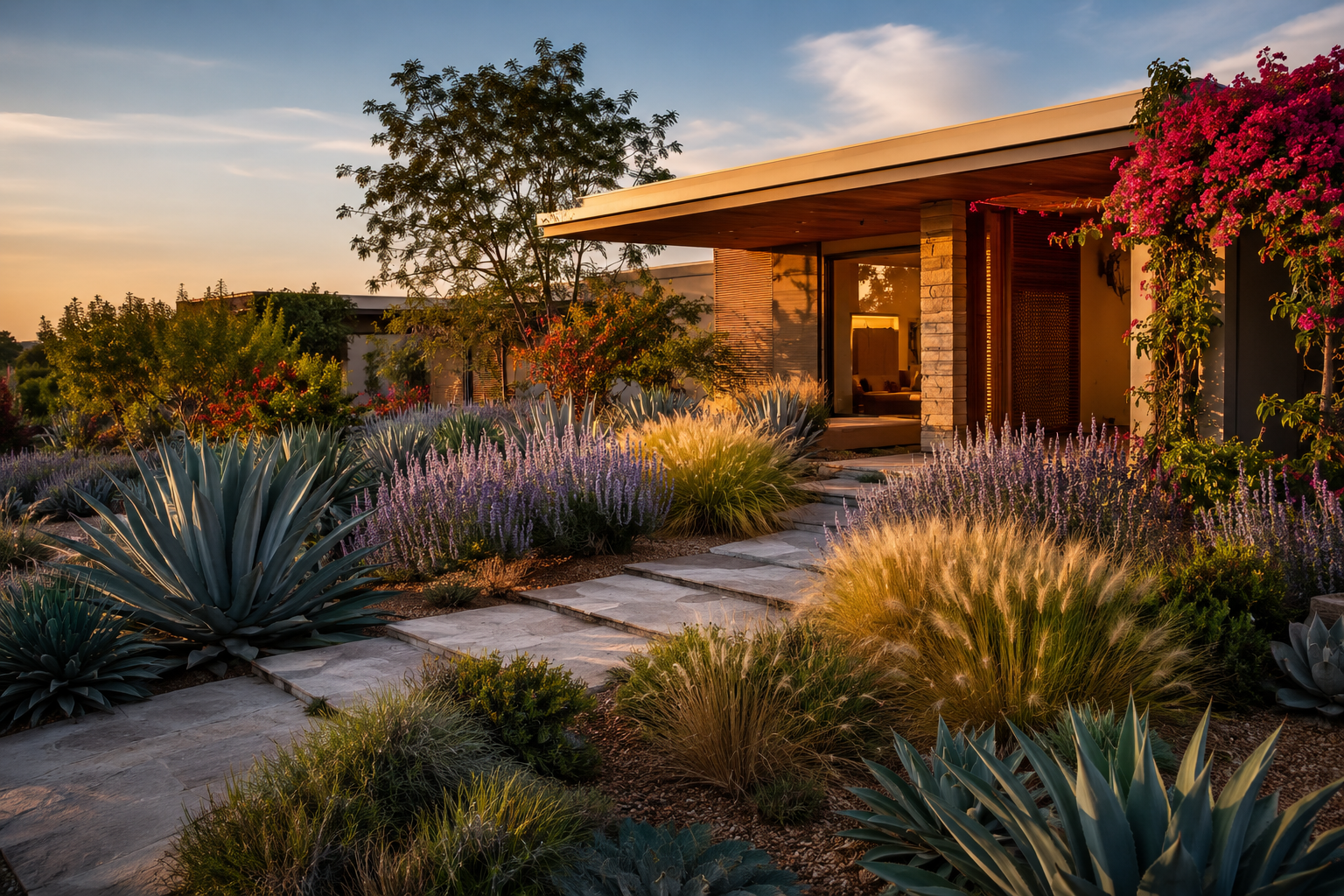
In regions with hot summers and low annual rainfall — including much of northwest India, the Arabian Peninsula, North Africa, and the American Southwest — drought-tolerant succulents, Mediterranean herbs, and indigenous desert shrubs perform best.
ARCNET Plant Selection Matrix
| Climate | Recommended Plants | Water Need | Notes |
| Hot-Dry | Agave, Bougainvillea, Lantana, Kaner (Oleander), Desert Rose (Adenium) | Very Low | Native or adapted; deep roots |
| Hot-Humid | Heliconia, Bird of Paradise, Bamboo, Frangipani, Ruellia | Low-Medium | Good drainage essential |
| Temperate | Lavender, Salvias, Rosemary, Ornamental Grasses, Echinacea | Low | Mulch in summer |
| Cold | Sedum, Creeping Thyme, Russian Sage, Native Wildflowers | Low-Medium | Snow acts as mulch |
| Tropical | Duranta, Plumbago, Bougainvillea, Torch Ginger, Cannas | Low-Medium | Rainfall usually sufficient |
| Mediterranean | Rockrose, Artemisia, Teucrium, Phlomis, Euphorbia | Very Low | Avoid summer watering once established |
💡 Native Plant Advantage
Native plants have evolved over thousands of years to survive the precise rainfall, temperature, and soil conditions of your region. Once established — typically after one full growing season with support — most require zero supplemental irrigation. A garden of 70–80% native species can essentially be self-sustaining in rainfall from its second year onward.
3.2 Hot-Humid Climate Planting
In humid tropical and subtropical climates (Kerala, Singapore, Jakarta, Queensland), the challenge is not drought but waterlogging. Water-wise design here means avoiding plants that rot in wet roots while choosing species that are resilient through dry season gaps.
Raised beds and mounded soil improve drainage dramatically. Heliconia, Plumbago, Acalypha, and native figs are excellent performers across most of Southeast Asia and coastal India.
✅ TIP
In humid climates, overwatering kills more plants than drought. If your soil stays moist for more than 3 days after rain, improve drainage with coarse sand and compost before planting drought-tolerant species.
3.3 Temperate and European Climate Planting
Across the UK, Europe, and temperate parts of Australia and New Zealand, summers are increasingly dry as climate patterns shift. Mediterranean garden styles — lavender borders, rosemary hedges, ornamental salvia — are performing better and requiring less water than traditional English-border annuals.
In the UK, replacing annual bedding plants with perennial drought-tolerant species can reduce summer irrigation by over 60%. The RHS Perfect For Pollinators list is an excellent free resource for UK homeowners.
3.4 Groundcovers and Living Mulches
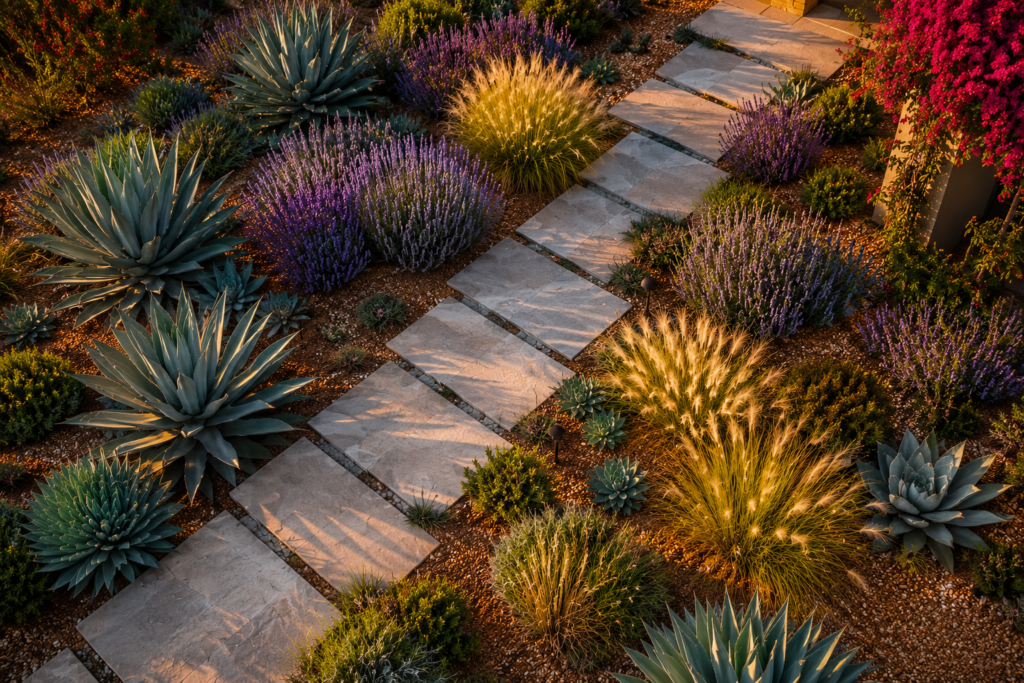
Groundcovers replace bare soil with living plants that suppress weeds, reduce evaporation, and protect against erosion. Low-growing options include Dichondra repens (Australia, New Zealand), Aptenia cordifolia (India, Middle East), Ice Plant (Carpobrotus), and Thymus serpyllum across temperate zones.
A groundcover layer adds biodiversity, attracts pollinators, and eliminates the need for chemical weed control — delivering multiple sustainability benefits with minimal water input.
⚠️ WARNING
Avoid invasive plants, even if they are drought-tolerant. Species like Lantana camara, while extremely hardy in India and Southeast Asia, are invasive in natural bushland. Always check your regional invasive species list before introducing new plants to your garden.
4. Soil Preparation and Mulching
No plant selection or irrigation system can compensate for poor soil. Healthy soil holds water where plant roots can access it, drains excess water before roots rot, and supports the microbial life that feeds your plants naturally. Mulch is the single most cost-effective water-saving intervention available to any homeowner.
4.1 Building Water-Retentive Soil
Most garden soils — especially in new housing developments where topsoil has been stripped — are compacted, nutrient-poor, or both. The solution is organic matter: compost, aged manure, leaf litter, or biochar.
Dig in 100–150mm of compost before planting. For sandy soils common in coastal areas, add water-retaining crystals (hydrogels) to hold moisture between irrigation cycles. For heavy clay soils common in temperate regions, incorporate gypsum and coarse sand to improve drainage.
💡 Biochar in Water-Wise Gardens
Biochar — a charcoal-like material produced by burning organic matter at low oxygen — is one of the most powerful soil amendments available for water-wise gardens. It improves water retention by up to 18%, increases microbial activity, and sequesters carbon. In India and Southeast Asia, rice husk biochar is widely available and affordable. A 5–10% biochar addition to your planting mix can meaningfully extend the time between irrigation cycles.
4.2 The Science of Mulching
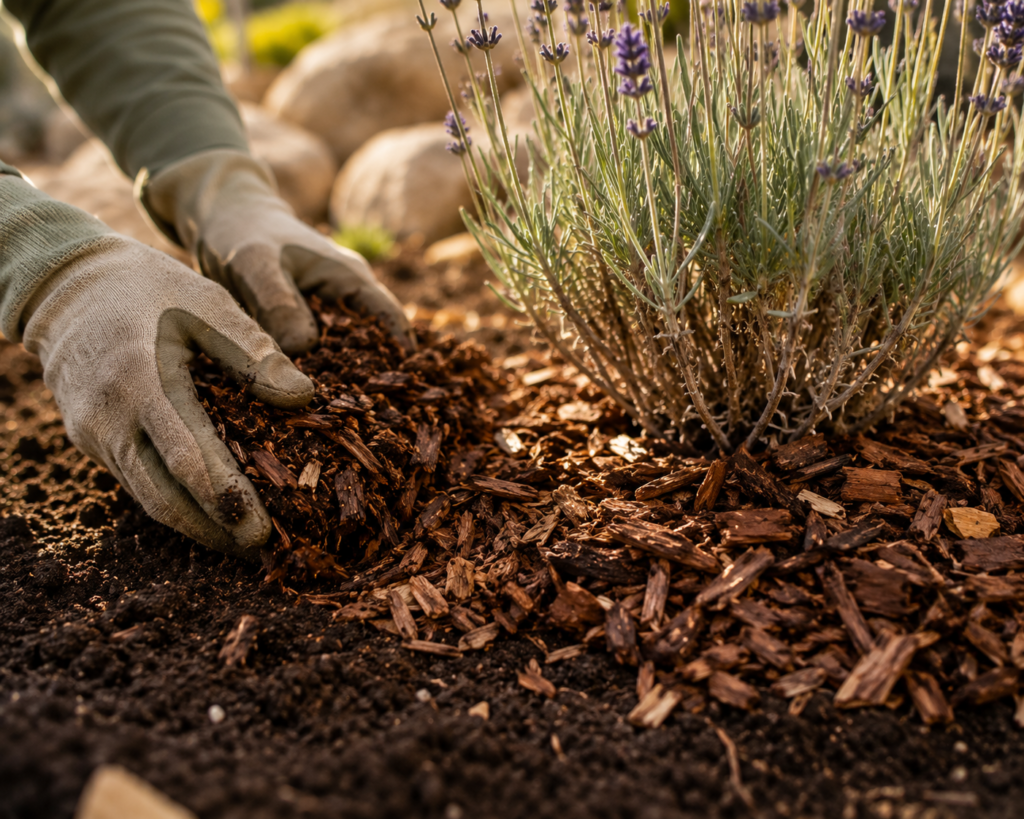
Mulch placed on top of the soil creates a physical barrier that blocks sunlight (suppressing weeds), reduces surface soil temperature, and dramatically slows evaporation. Studies show that 75mm of organic mulch can reduce soil moisture evaporation by up to 70%.
Apply mulch 75–100mm deep around plants, keeping it 50–75mm away from plant stems to prevent collar rot. Replenish every 6–12 months as it breaks down — this breakdown actually feeds your soil, creating a self-improving cycle.
✅ TIP
The best mulches for hot climates are chunky wood chips (not fine sawdust), composted bark, or crushed rock. Fine mulches compact and shed water. Chunky mulches allow water to penetrate while still blocking evaporation. For ornamental beds, crushed granite or recycled glass mulch adds visual interest while providing the same water-retention benefit.
4.3 Compost as Living Infrastructure
Compost is not just a soil supplement — it is living infrastructure. A compost-rich soil hosts billions of microorganisms that cycle nutrients, suppress disease, and maintain soil structure. Plants growing in compost-rich soil develop deeper, more extensive root systems that access moisture further from the surface — making them more drought-resistant even without supplemental irrigation.
Making your own compost from kitchen scraps and garden clippings is practical, low-cost, and can supply the majority of your annual soil amendment needs for a medium-sized garden.
4.4 Soil Testing Before You Amend
Before adding amendments, test your soil’s pH, drainage rate, and nutrient levels. Inexpensive home test kits are available online for under ₹500 in India or £15 in the UK. Knowing whether your soil is acidic, alkaline, sandy, or clay-heavy allows you to match amendments precisely rather than guessing — saving money and producing far better results.
⚠️ WARNING
Never add fresh manure directly to planting beds. Fresh manure is high in nitrogen and salts that can burn plant roots and create nutrient runoff. Always use composted or aged manure that has been allowed to break down for at least 3–4 months.
5. Irrigation Systems Guide
No matter how well you plan and plant, occasional irrigation is necessary in most climates — especially during plant establishment. The system you choose determines how much water you actually use. The right system delivers water exactly where roots need it, at the right time, with minimal waste.
5.1 Drip Irrigation — The Gold Standard
Drip irrigation delivers water directly to the root zone via slow-release emitters. Water goes into the soil rather than onto foliage or pathways. Compared to overhead sprinklers, drip irrigation reduces water use by 30–50% and dramatically reduces fungal disease by keeping foliage dry.
Drip systems are suitable for garden beds, planter boxes, vegetable gardens, and container plants. They can be automated with a timer for under ₹3,000–5,000 for a small garden in India, or £40–80 in the UK.
ARCNET Irrigation System Comparison Guide
| System | Water Saving vs. Sprinkler | Best For | Cost (India) | Cost (UK/AU) |
| Drip Irrigation | 30–50% | Beds, borders, vegetables | ₹2,000–8,000 | £30–120 |
| Soaker Hose | 25–40% | Rows, hedges, borders | ₹800–2,000 | £15–50 |
| Smart Controller + Sensor | 20–30% additional | All systems | ₹3,000–10,000 | £40–150 |
| Subsurface Drip | 40–60% | Lawns, large beds | ₹8,000–25,000 | £150–400 |
| Overhead Sprinkler | Baseline (0%) | Turf only — avoid for beds | ₹1,500–6,000 | £20–100 |
| Rainwater Tank + Drip | 50–75% | Any garden | ₹15,000–40,000 | £200–800 |
💡 Smart Irrigation Controllers
Smart irrigation controllers connect to local weather forecasts and automatically skip watering cycles when rain is expected. Studies show smart controllers reduce outdoor water use by 15–25% compared to standard timers — without any change to the garden design itself. Brands like Rachio (USA), Hunter (global), and Rain Bird (global) offer models compatible with standard Indian and European 12V solenoid valves.
5.2 Soaker Hoses for Borders and Rows
Soaker hoses are porous rubber or polyethylene tubes that sweat water along their entire length. They are ideal for long planting rows, hedge lines, and perennial borders. Lay them along the drip line of plants (not at the stem base) and cover with mulch. Connected to a timer, a soaker hose system practically runs itself.
✅ TIP
Water at dawn, not midday. Dawn watering reduces evaporation loss by up to 30% compared to afternoon irrigation. It also reduces fungal disease by ensuring leaves dry before nightfall.
5.3 Greywater Reuse
Greywater — the water from sinks, showers, and washing machines — can be redirected to garden irrigation with simple systems. In India, this is legal and increasingly encouraged. In Australia and many European countries, greywater reuse requires a basic approved diversion system.
Avoid greywater from kitchen sinks (food grease blocks soil pores) and only use laundry greywater if you use phosphate-free, plant-safe detergent. Never use greywater on vegetables grown for direct consumption.
5.4 Timing and Scheduling Irrigation
When you water matters almost as much as how you water. The optimal window is between 4am and 8am. At this time, evaporation is lowest, pressure in municipal water mains is highest, and plants have time to absorb moisture before midday heat. Avoid evening watering in humid climates — wet soil overnight accelerates fungal disease.
⚠️ WARNING
A single leaking drip emitter or cracked soaker hose can waste thousands of litres before you notice it if the system runs underground or under mulch. Check your entire irrigation system visually at least once a month, and install a flow meter or smart sensor that alerts you to unexpected water use spikes.
6. Garden Planning Worksheet and Design Framework
A good water-wise garden doesn’t happen by chance — it starts on paper. This section provides a practical framework to design your garden from scratch or adapt an existing layout. Use the Garden Planning Worksheet below as your starting point.
6.1 Site Analysis: What to Map Before You Design
Before drawing anything, spend at least one week observing your site at different times of day. Document the following:
- Sunrise and sunset position relative to your garden
- Areas of full sun (6+ hours daily), part-shade (3–6 hours), and deep shade (<3 hours)
- Existing drainage patterns — where does water pool after rain?
- Wind exposure — which areas are exposed to drying winds?
- Existing plants — which can stay, which should be removed?
- Water source locations — where are taps, downpipes, and mains connections?
Water-Wise Garden Planning Worksheet
| Planning Step | Question to Answer | My Notes |
| 1. Site Dimensions | What is the total garden area (sqm)? | |
| 2. Climate Zone | Hot-dry / Hot-humid / Temperate / Cold? | |
| 3. Annual Rainfall | What is your average annual rainfall (mm)? | |
| 4. Soil Type | Sandy / Clay / Loam? Any waterlogging? | |
| 5. Sun Mapping | Where are the full-sun, shade, and wind zones? | |
| 6. Water Source | Mains / Bore / Rainwater tank / Greywater? | |
| 7. Budget | Total budget for soil, plants, and irrigation? | |
| 8. Priorities | Edibles / Ornamentals / Wildlife / Privacy? | |
| 9. Time Available | Hours per month for garden maintenance? | |
| 10. Existing Plants | Which stay, which go, which need relocation? |
💡 Free Planning Tools
Google Earth Pro (free) lets you measure your garden dimensions precisely. Sun Surveyor (app) maps sun angles and shadow patterns through the year at your exact location. These two free tools can replace hours of manual observation and make your plant zoning dramatically more accurate.
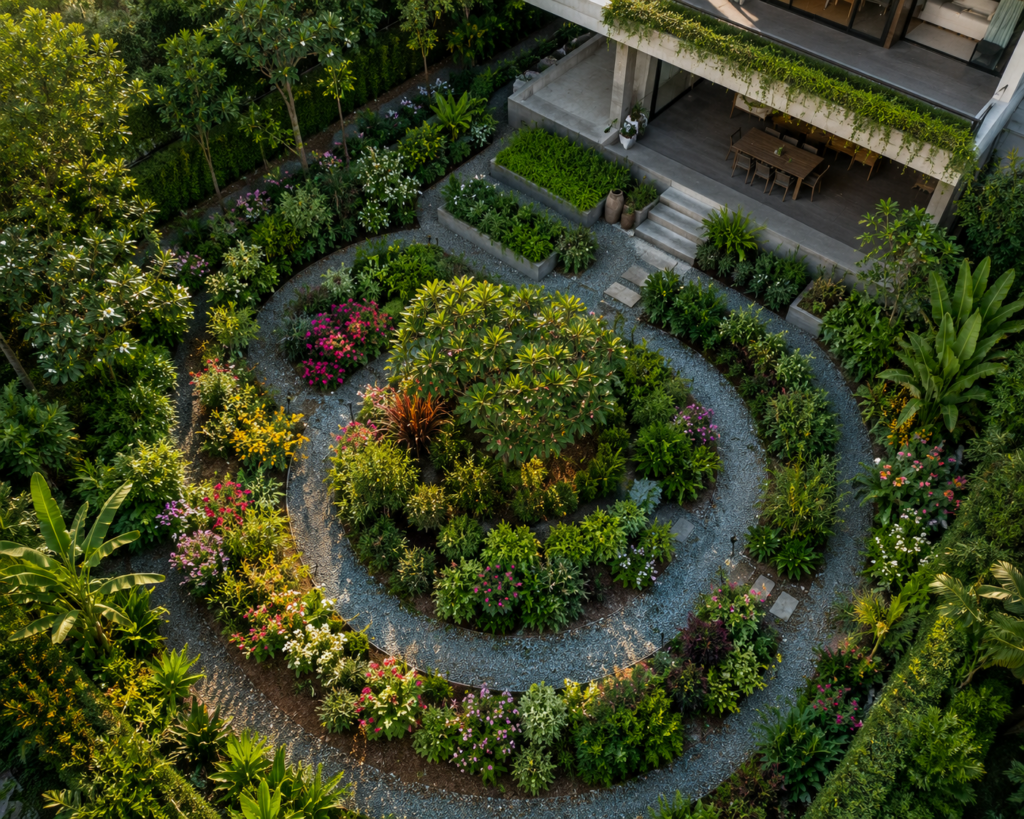
6.2 Zone Planning: The Three-Ring Approach
Divide your garden into three concentric rings of water intensity:
- Ring 1 (closest to house): Kitchen garden, container plants, feature planting — higher water, highest visibility, easiest to irrigate
- Ring 2 (middle zone): Perennial borders, ornamental grasses, shrubs — medium water, established with drip irrigation
- Ring 3 (boundary zone): Native trees and shrubs, groundcovers — low or zero supplemental water once established
This zoning approach ensures that your highest-maintenance plants are easiest to care for, while your boundaries become increasingly self-sufficient.
6.3 Water Saving Checklist (Pre-Installation)
Before you install any new planting or irrigation, verify these points:
☐ Soil tested and amended with compost where needed
☐ All plant selections confirmed against climate zone suitability
☐ Mulch sourced and ready to apply at 75mm depth
☐ Drip or soaker irrigation planned for every watered zone
☐ Timer or smart controller purchased and programmed
☐ Rainwater tank position confirmed (if applicable)
☐ Greywater system designed (if applicable)
☐ Plant zones mapped: high, medium, and low water clearly marked
✅ TIP
Take photos of your site before and after each stage of your water-wise redesign. Garden transformations are one of the most shared content types on Instagram and Pinterest — and your own documentation becomes valuable for future maintenance decisions.
6.4 Phasing Your Water-Wise Transition
You do not need to transform your entire garden in one season. A phased approach spreads cost, effort, and learning across 2–3 years.
- Year 1: Improve soil across entire garden. Install core irrigation. Replace highest-water areas first.
- Year 2: Expand native planting. Add rainwater tank. Sheet-mulch remaining lawn areas.
- Year 3: Remove remaining irrigation from established low-water zones. Focus on habitat and biodiversity planting.
⚠️ WARNING
Do not remove irrigation from a newly planted water-wise garden before plants are fully established — typically 12–18 months after planting. Young drought-tolerant plants are not yet drought-tolerant; their root systems have not yet reached stable deep moisture. Removing water too early is the most common cause of failure in new xeriscaped gardens.
30-Day Action Plan: Your Water-Wise Garden Launch
| Week | Focus | Actions |
| Week 1 | Assess and Plan | Map sun/shade zones. Measure garden area. Identify soil type. Note existing water sources and drainage patterns. |
| Week 2 | Soil and Mulch | Purchase and apply compost. Lay first mulch layer (75mm) across all existing beds. Remove weeds before mulching. |
| Week 3 | Irrigation Setup | Install drip irrigation or soaker hose in primary beds. Connect timer. Check for leaks. Program dawn watering cycles. |
| Week 4 | Plant and Review | Replace one high-water area with drought-tolerant natives or gravel. Review water bill from previous month. Set goals for Month 2. |
Frequently Asked Questions
Q1: How much water can xeriscaping actually save?
Independent studies from the US Environmental Protection Agency and municipal water authorities in Australia consistently show that xeriscaped gardens use 50–75% less water than conventional gardens with turf and annual planting. In extremely water-wise designs using native plants and no irrigation beyond establishment, savings of 90% are achievable.
Q2: Can I xeriscape a garden in a humid tropical climate?
Absolutely. In humid climates like Singapore, Kerala, or coastal Queensland, water-wise design focuses on drainage, plant selection, and eliminating unnecessary irrigation — not drought-proofing. Choosing native and adapted species, improving soil drainage, and removing overhead irrigation from established trees are the key strategies.
Q3: What is the cheapest way to start a water-wise garden?
Mulching is the highest-value, lowest-cost intervention available. A single layer of 75mm wood chip mulch across your existing beds, applied in a weekend, can reduce irrigation needs by up to 70% immediately. Sourcing mulch from a local arborist (often free) makes this nearly cost-free.
Q4: How long does it take for a drought-tolerant garden to establish?
Most drought-tolerant plants need 12–18 months of supplemental irrigation to develop root systems deep enough to access ground moisture independently. Plant in early autumn (temperate climates) or at the start of the cooler dry season (tropical climates) to give roots time to establish before their first serious heat stress.
Q5: Does a water-wise garden look bare or dry?
Only if it is poorly designed. A well-planned water-wise garden uses layered planting — tall shrubs or small trees for structure, medium shrubs for volume, groundcovers and grasses for texture — combined with strategic use of colour through drought-tolerant flowering plants. Many of the world’s most beautiful gardens are water-wise: the gardens of Alhambra in Spain, Adelaide Botanic Garden’s Australian Arid Lands exhibit, and countless private gardens across coastal California and South India.
Quick Wins Checklist
You don’t need a full garden overhaul to start saving water. Try these changes this week:
☐ Replace one section of lawn with gravel, mulch, or native groundcover
☐ Install a drip irrigation line to your most thirsty garden bed
☐ Apply 75mm of mulch around all existing plants
☐ Group plants with similar watering needs together
☐ Add a rain sensor or smart controller to your existing irrigation system
☐ Remove one high-water plant and replace it with a drought-tolerant native
☐ Set irrigation to water at dawn, not midday
☐ Fix any leaking taps or irrigation joints before the next watering cycle
Download Your Free Water-Wise Garden Planner
A complete planning guide with the Plant Selection Matrix, Irrigation Comparison Guide, Garden Planning Worksheet, and Water Saving Checklist — all in one downloadable resource.
Continue Exploring on ARCNET
| 🌧️ Coming Soon – Rainwater Harvesting for Homes How to design, size, and install a domestic rainwater harvesting system that works year-round. | 🌿 Coming Soon – Native Plant Landscaping Guide A deep-dive into sourcing, planting, and maintaining native species across South Asia, Southeast Asia, and Australasia. |
| 🏡 Coming Soon – Sustainable Landscape Design 101 The complete ARCNET framework for designing a landscape that is beautiful, low-maintenance, and environmentally responsible. | 🌞 Coming Soon – Climate-Responsive Garden Design How to design outdoor spaces that adapt to your specific climate — from tropical monsoon to alpine. |